

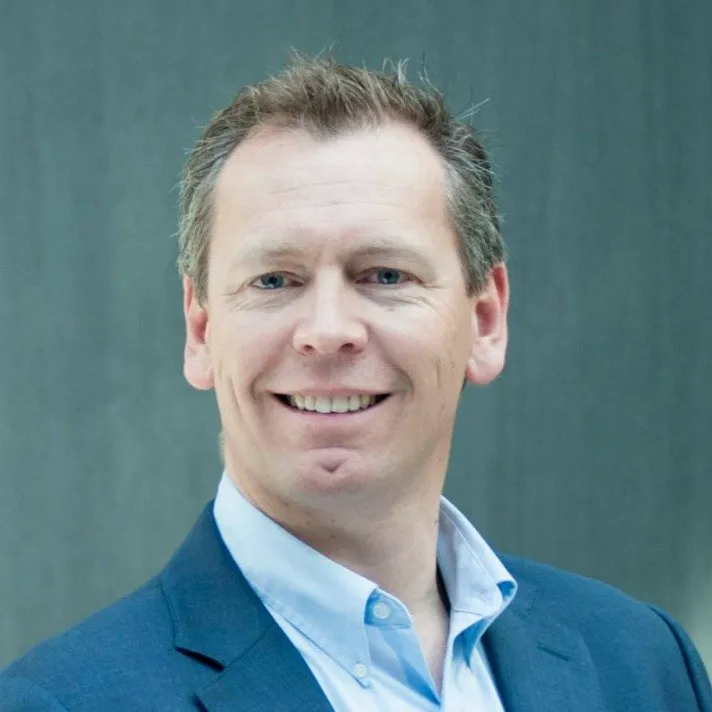
In October 2024 we hosted a deep dive webinar, Building a GP accelerator, with Jonathan Hollis , founder of Mountside Ventures as guest speakers. Our topic: How to build great programs in the evolving field in Europe. Our tool: the GP Accelerator Business Model Canvas
Read also part I: Building a GP accelerator
The GP Accelerator Business Model Canvas provides a structured framework for designing and launching a successful program. This tool helps program creators think systematically about all key components behind a successful GP accelerator.
What Is A The GP Accelerator Business Model?
The GP Accelerator Business Model is both a strategy framework and a financing model for how you are going to build, scale and finance your GP accelerator.
What Is A The GP Accelerator Business Model Canvas?
Inspired by the work by Alex and Yves, on the original business model canvas back in 2008, and further developed by our work at Strategy Tools, the GPABMC provides you with a one-page, visual, simple framework to map, sketch and test the business model behind your GP accelerator, either something you have running today or something you are considering for the future.
Staying close to the original BMC, we have stayed with ten unique boxes. These are:.
- Value proposition
- Channels
- Relationships
- Target audience
- Target funders
- Revenue, income side
- Cost side
- Key partners
- Program design
- Secret sauce
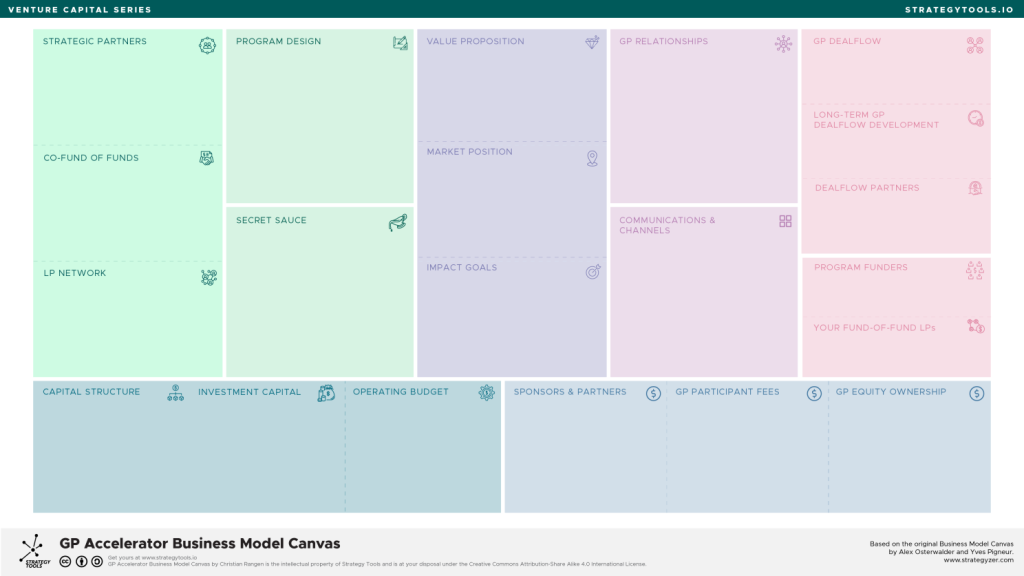
Digging deeper, we then have a total of 21 unique categories we look at, when designing the GP accelerator in more detail.
- Value proposition
- Market position
- Impact goals
- Communications & channels
- GP Relationships
- GP deal flow
- Long-term GP deal flow development
- Deal flow partners
- Program funders
- Your fund-of-fund LPs (only applicable if you are planning to run your own LP-funded fund, as a part of the accelerator. Not a requirement)
- Sponsors & partners
- GP participants fee
- GP equity ownership
- Operating budget
- Investment capital (only applicable if you are planning to run your own LP-funded fund, as a part of the accelerator. Not a requirement)
- Capital structure
- Strategic partners
- Co-fund-of-funds
- LP network
- Program design
- Secret sauce
Download The GP Accelerator Business Model Canvas here. Share How You Use It.
Case Study: GIA – Global Impact GP Accelerator
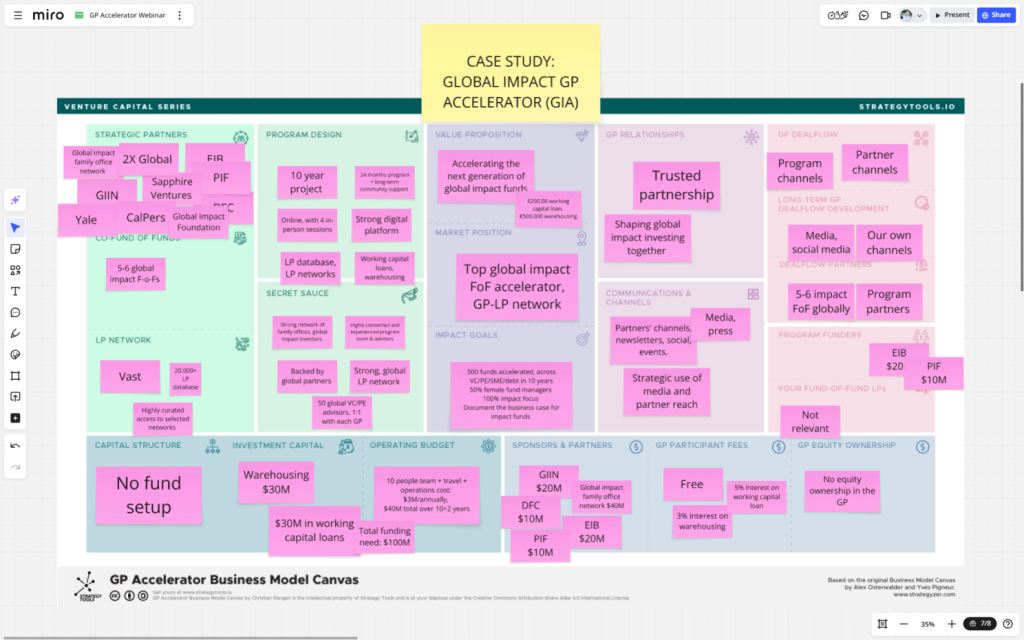
The GIA case was covered in the October ’24 webinar. GIA is based on a brand-new, global GP accelerator we have been helping develop. The program is still being developed, but this program can end up having massive global reach and impact once it goes live.
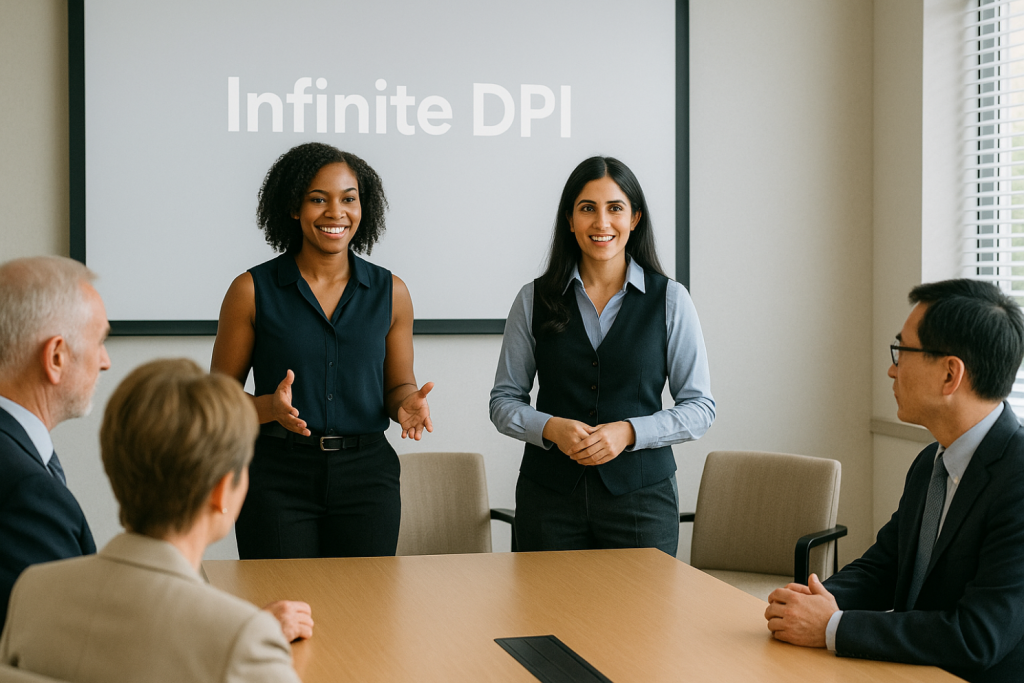
Two GIA participants in a pitch training session with institutional allocators, just starting their discussions on impact investing. A program like GIA will provide access to LPS. P.s. There are no guarantees of infinite DPI….
Case Study: NEDVCA – Northern Europe Deeptech VC Accelerator
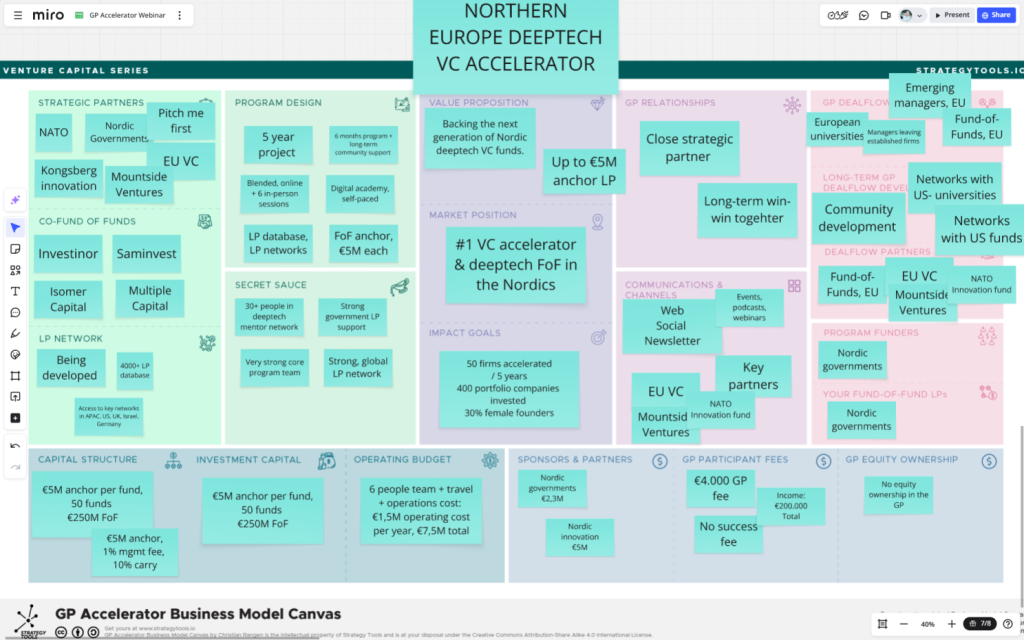
Case: Northern Europe Deeptech VC accelerator
The GIA case was covered in the October ’24 webinar. GIA is based on a brand-new, global GP accelerator we have been helping develop. The program is still being developed, but this program can end up having massive global reach and impact once it goes live.

Nordic deep tech (dual use) does not get built in the lab, but in the field. Emerging VCs doing deal flow development in the deep Swedish forests, exploring autonomous drone swarms for a possible Series A. The next Helsing, maybe? Get in early.
Comparing The Two
What is interesting here is to compare the two and see how they are similar, but mostly different. Both models are viable and have the opportunity to truly establish themselves in the market.
One has a fee, €4.000. The other is free.
One has an in-house F-o-F, virtually guaranteeing anchor LP backing. The other don’t.
One has global sponsors, the other is regional public sector only.
Using the two examples, we can see a number of differences in how they shape and build their GP accelerator business models. There is no one right answer, but using this, we can quickly identify what are the key areas (ten boxes) and key topics (21) to explore
Case Study: MEMA – MENA Emerging Managers Accelerator
In article one, Building a GP accelerator, we explored the MEMA – a brand new, fictional GP accelerator based in Dubai, at DTEC. Let’s take a look at how this GP accelerator business model might look like.
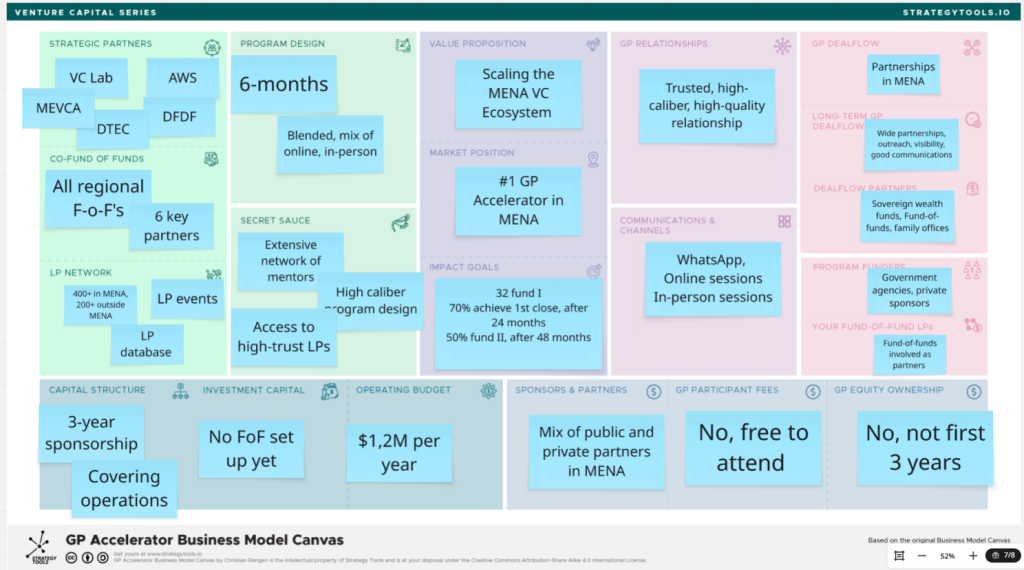
GP Accelerator Business Model Canvas (Rangen, 2024, based on Osterwalder, Pigneur)
1. Purpose
MEMA is created to support the emergence of a new generation specialized VCs and PE funds across the MENA region, addressing the gap between abundant regional capital and the lack of experienced local fund managers capable of identifying and scaling high-growth opportunities from seed to exit. The ultimate purpose: contribute to scaling the MENA VC ecosystem.
Value Proposition
- Cross-border investment expertise spanning 16 MENA markets
- Get sovereign wealth fund and family office network access
- Regulatory navigation across multiple jurisdictions
- ESG and impact investing integration
2. Market position
To become the #1 GP accelerator in MENA, on the assumption that several will emerge in the coming years.
3. Impact Target Results After 3 Years:
- 32 fund managers completed program representing 7 MENA countries
- 70% achieved first close within 24 months (benefiting from government backing and regional LP network)
- 25 cross-border co-investment partnerships established between cohort members
- $3.2B in new regional fund commitments raised
- 8 funds completed successful portfolio company mark-ups
- 50% of participating funds exploring raising fund II the following year.
6. GP deal flow
- Sovereign wealth fund and government agency referrals
- MENA Private Equity Association partnership promotion
- Regional family office network introductions
- Strategic presence at major regional conferences (ABLF, STEP, etc.)
9. Program funders
- UAE Federal Government innovation grant program
- Co-funding from Saudi Vision 2030 economic diversification initiative
- DIFC strategic partnership contribution
- Qatar Development Bank regional development funding
- Corporate sponsorship from major regional banks and consulting firms
11. Sponsors & Partners (evolving)
- Fully grant and partnership-funded for first four years
- Gradual transition to mixed model incorporating program fees
- Primary focus on regional ecosystem development and cross-border collaboration
- Success measured by aggregate regional AUM growth and cross-border deal flow
17. Strategic partners
- 15 leading MENA-focused VCs and PE firms as mentors
- Partnerships with sovereign wealth funds from UAE, Saudi Arabia, Qatar, and Kuwait
- Government investment agencies from 8 MENA countries
- Dubai International Financial Centre as institutional anchor partner
- Strategic alliance with Islamic Development Bank
19. LP Network, LP Database, Reach and Relationships
- 45 institutional LPs across the MENA region
- 12 sovereign wealth funds and government co-investment vehicles
- 35+ prominent family offices from MENA
- Corporate venture arms from regional conglomerates
- Development finance institutions focused on MENA markets
- Angel networks and HNWI’s
20. Program Design
- 6-months program with in-person deep dives across Dubai, Abu Dhabi Riyadh, and Cairo
- Cross-cultural investment workshops and regulatory deep-dives
- Sovereign wealth fund relationship development track
- Sharia-compliance and ESG integration modules
- Multi-jurisdictional fund structuring support
Team
- Program Director: Former Abraaj Group partner with 12 years MENA experience
- Regional Advisor: Ex-Managing Director of Dubai International Financial Centre
- Government Relations: Former economic development executive from Saudi Arabia’s PIF
- Cultural Integration Specialist: Multi-lingual professional with family office background across GCC
Timeline To Bring To Life
- 12 months development phase with government and SWF partners
- Pilot program with 8 participants from 3-6 different countries
- Annual cohorts of 12-15 managers representing diverse regional markets
- 7-year commitment to building integrated MENA investment ecosystem
Using the fictional GP accelerator Program, MEMA, we see how the MENA region, and its VC ecosystem could quickly get strengthened with a dedicated, region-wide GP accelerator.

LP discovery process, one of the key building blocks of the program. Get out of the building and talk to your customers. Note, in this case, your customers are a wide range of prospective Limited Partners. Use this insight to develop your LP Personas
From Sketch To Action
The examples listed above are all based on real-life projects we have worked on.
For any ecosystem builder, innovation agency, national fund-of-fund, VC association, innovate family office or future-shaping investor; we have learned how to build highly successful startup accelerators. They are everywhere now.
Let’s lift our focus further and start developing GP accelerators. Based on the same principles, a GP accelerator can have profound impact on your ecosystem.
Need a tool for the job? Explore the GP Accelerator Business Model Canvas. Get it here.
Read also part I: Building a GP accelerator
Want to learn more about GP accelerators? In August we publish the Building a GP Accelerator e-book. Pre-register today.
Chris Rangen is a fund strategy advisor who has worked with 250+ emerging fund managers globally. He runs global VC Masterclasses and teaches at leading programs like IMD’s Venture Asset Management Program, led by Jim Pulcrano (Lausanne), and Newton Venture Program (London).
Over the past five years, he has designed and run 3 GP accelerators in collaboration with 2X GP Sprint, and he has helped design five more programs.
Ten years ago he was deeply fascinated by how startup accelerators could be a force for acceleration and growth. Today, he is deeply focused on how GP accelerators can shift markets and develop ecosystems around the world.
Reach Chris at [email protected] or WhatsApp: +4792415949