


EXECUTIVE SUMMARY
Mastery in Scale Up facilitation is not a credential you earn; it is a progression you live. Over 18 to 36 months, you will evolve from content expert to transformer; someone who helps founders and teams see what they could not see alone.
This journey unfolds through four phases that build on each other: Learn your craft deeply, Run programs to develop instinct, Apply your voice to client contexts, and Fly with the mastery that makes breakthrough moments seem effortless.
The result is not perfection, but the hard-won ability to orchestrate genuine transformation for the entrepreneurs and ecosystems you serve.
WHICH PHASE ARE YOU IN?
You might be starting from zero; in which case, Phase 1 is your entry point. But more likely, you are already somewhere in the journey. Reading about frameworks for the first time? Phase 1 is your entry. Running a few programs but lacking confidence and wondering if you are on track? Jump into Phase 2’s feedback mechanisms. Already designing custom programs and finding your voice? Apply is your home; now deepen it. Experienced facilitators from other teaching contexts? You may progress quickly, but do not skip the underlying principles. The journey is not about following a rigid timeline; it is about honest assessment of your current capability and intentional growth from there.
PHASE 1: LEARN — Building Your Foundation & Authority
The Foundation: Why You Are Studying
Before you run anything, you must understand that learning here is not passive. You are building the internal library that allows real improvisation later. Study is not preparation for facilitation; it is foundational to it.
Visual Thinking and Frameworks
Start with visual thinking, not slides. Transform strategic complexity into clarity with canvases like the Founder’s Journey, Investor Map, Long Term Funding Journey, the Rocketship Canvas, and the ecosystem of 500 plus others. It is about externalizing mental models and guiding discovery, not dictating solutions.
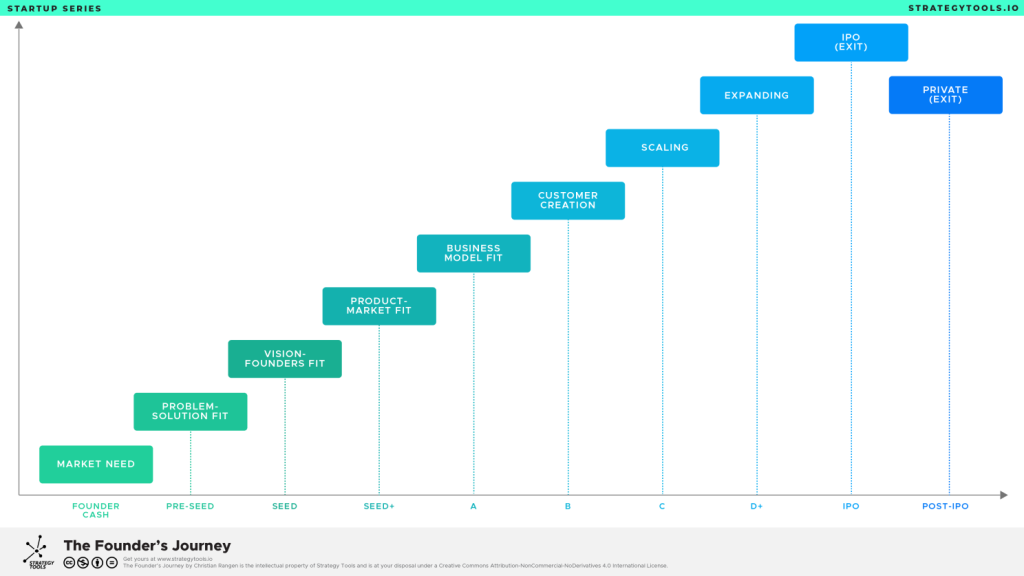
Early in my career with Connect BAN (Norwegian Business Angel Network), I watched Christian Rangen map a founder’s tangled business concept onto three canvases. Suddenly, confusion became clarity; not through explanation, but by making thinking visible. That moment taught me: visual thinking is the language of transformation. You must become fluent in it.
Simulation Engine Mastery
Simulations are not games. They are structured decision pathways, cap table mathematics, scenario dynamics, and feedback loops that teach through consequence, not lecture. When I first encountered the Scale Up simulation at Strategytools.io, I realized how architected choices; with Boom & Bust cards representing real market shocks, founder departures, acquisition offers; drive insight no textbook could match.
Understand the mechanics deeply:
- How dilution cascades across three funding rounds
- When a founder realizes their equity stake has shrunk more than they imagined
- The psychological shifts that happen when a market crash scenario card appears mid simulation
- Why founders who race for capital early often encounter their hardest lessons by Round 3
- This knowledge becomes intuitive only through study and playing the simulation yourself as a participant.
Content Universe and Case Studies
Master facilitators continuously expand their knowledge. Read the essentials; Venture Deals, Zero to One, Blitzscaling, The Hard Thing About Hard Things, Grit, The Lean Startup; but read them from multiple perspectives: as founder, as investor, as board member. Each lens matters.
Build a living case study library, categorized by region, industry, stage, and challenge. When you are facilitating with Blue Tech, Clean Tech, Climate Tech, and Agro Tech founders at Katapult (https://www.strategytools.io/case-studies/how-katapult-accelerator-gets-its-startupsinvestor-ready/), or AI + Impact scale ups through INCO Ventures GrowAI program mentoring, or ecosystem builders in Lebanon, North Macedonia, or Serbia, you have sectoral and regional context ready. This is not showing off; it is preparation that signals you have done your homework.
Learning Intensity and Timeline
This phase requires 3 to 6 months of serious engagement: deep study of visual methods, running simulations as a participant first, reviewing scenario cards until their logic becomes intuitive, and cultivating that living knowledge base. You know you have succeeded not when “you know it all,” but when you can hold confident, contextual conversations with founders and investors from any background, in any sector.
The Learning Principle: You are building the internal library that allows real improvisation later.
PHASE 2: RUN — Building Capability & Confidence
The Nervous System of Facilitation
This phase develops something no book teaches: the ability to sense what a room needs moment to moment. You are building the nervous system to feel energy shifts, recognize when someone’s struggle is their learning edge, and know when to intervene versus let silence work.
I remember my first solo facilitation at Katapult with a founder cohort. I was terrified. I had co facilitated before, but this was different; I was alone, responsible for Sixteen founders’ learning experience over two full days. I made mistakes. I mistimed a break. I let one discussion run too long. But those founders learned, and; crucially; so did I. Each mistake taught me something about presence and adaptation.
The Progression of Facilitation Practice
You do not jump to leading. You build through stages:
- Support: Participate in someone else’s run first. Watch a master work. Observe their interventions, their pacing, their choices. Get comfortable with the material while someone else holds the container.
- Co Facilitate with Masters: This is where real learning happens. Work alongside experienced facilitators like Christian Rangen, Rick Rasmussen , or Scott Newton. Learn not just what they do, but why they do it at each moment. Watch how they read the room. Observe what they notice that you missed.
- Lead a Full Simulation: After sufficient support and co facilitation, you lead. You make decisions about timing, interventions, pacing. You experience the full responsibility and joy of facilitation. You also experience what it feels like when things go sideways; and how to recover.
- Design Program Variations: From one day intensives to five day journeys to six month ecosystem programs, each length requires different facilitation skills. Through work across 20+ client engagements, I have run them all. Short formats demand clarity and energy. Long formats require building relationships and holding participants through vulnerability. You need both capabilities.
Feedback: The Engine of Development
This phase lives or dies by feedback. Not generic praise, but honest reflection:
- From mentors watching you facilitate
- From peers who co facilitated with you
- From participants on what landed and what did not
- From your own observation, record a session and watch yourself with curiosity, not judgment
Develop the discipline to ask: “What did I miss? Where did I lose someone? When did energy drop and why? What surprised me about how this group learned?”
Varied Contexts Accelerate Learning
Run in different settings to expand your capabilities:
- Free runs or educational settings: Low commercial pressure allows experimentation. You can try something new without stakes.
- University programs and student cohorts reason differently than accelerator founders or corporate executives. They bring fresh perspectives and different readiness for risk.
Some examples:
Students at FHV – Vorarlberg University of Applied Sciences Dornbirn https://www.linkedin.com/posts/foresight-strategy-entrepreneurship_entrepreneurship-experientiallearning-scaleup-activity-7377660996145872896-YeTC and https://www.strategytools.io/vorarlberg/
Students at ESCP Business School Berlin https://www.linkedin.com/posts/foresight-strategy-entrepreneurship_cleantechunicorns-escpberlin-entrepreneurshipeducation-activity-7245014267207237632-psyw?
Early incubators WeAreFounders Brussels https://www.linkedin.com/posts/foresight-strategy-entrepreneurship_wearefounders-entrepreneurship-becentral-activity-7201578986525589504-NKri
- Accelerator cohorts: Each cohort brings unique challenges, industries, and founder psychology.
Savant Build program: https://www.linkedin.com/posts/savant-technology-venture-fund-incubator_savant-build-programme-cape-town-intensive-activity-7341737624505610241-WhF0?
Each context teaches you something new about facilitation.
Practice Timeline and Output
In 4 to 8 months of regular running, at least twice monthly, expect confidence to emerge. Your intuition develops. You are responding to the room, not following a script. You have facilitated your first awkward session and recovered. You have seen the moment when a founder’s understanding shifts. You know what that moment looks like, and you are beginning to create the conditions for it intentionally.
The Facilitation Principle: You are developing the nervous system to sense what a room needs moment to moment. Expertise is not about knowing more; it is about sensing deeper.

PHASE 3: APPLY — Adapting, Customizing & Creating
Moving Beyond the Template
Now you are not just running what exists; you are adapting it, merging it with other frameworks, and inventing new applications. This is where you develop your unique voice as a facilitator. Generic facilitation rarely works. Customization builds client ownership faster than any pitch.
Co Design With Clients
Listen deeply before designing. Understand their strategy, their real challenge, not just their stated one:
- What is the strategic question keeping the CEO up at night?
- Where do teams misalign?
- What conversations are they avoiding?
Share what is possible: different configurations, approaches, extensions. Let clients see the thinking behind choices. Design together. Buy in emerges from partnership.
Example: Swiss EP – Swiss Entrepreneurship Program brought together innovation teams from Peru, Vietnam, and Croatia to Zug for intensive ecosystem building work. They were not looking for standard Scale Up curriculum. They needed to think simultaneously about ecosystem dynamics, market conditions in emerging economies, and founder psychology across regions. The simulation remained core, but pre work addressed ecosystem mapping, debrief questions focused on ecosystem leverage, and post program design included peer mentoring structures across geographies. That is co design in action.
Merge Frameworks & Adapt for Context
The best facilitators do not present Strategytools at clients. They integrate Strategytools into the client’s world:
- Merge with OKRs, Lean Canvas, Jobs to Be Done, Business Model Canvas, Disciplined Entrepreneurship, Foresight.
- Adapt for industry: Fintech founders think differently than climate tech founders
- Customize for stage: Early-stage founders need different dilemmas than growth stage founders
Adjust for ecosystem: A Norwegian corporate faces different challenges than an emerging market accelerator
When I worked with ecosystem development initiatives in Lebanon, North Macedonia, and Serbia, with Ljubisa Petrovic Victor Haze I realized that customization meant more than adapting content; it meant understanding the specific regional barriers to entrepreneurship, the investor mentality, the founder readiness in those markets. At Katapult, working with Blue Tech, Clean Tech, Climate Tech, and Agro Tech founders, customization meant embedding sustainability frameworks and resource scarcity into simulation dilemmas. When mentoring AI + Impact scale ups through Inco Social Tides, the adaptation was about impact measurement, technology ethics, and scalable social value alongside commercial thinking. A VC fund in the Gulf region required the same deep adaptation: regional case studies, their portfolio company challenges, their specific investment thesis woven throughout.
Invent & Test New Approaches
Once you understand the engine, you can innovate. Try new scenario combinations that create fresh dilemmas. Design additional canvases for specific challenges. Create extensions that take founders from simulation learning to real application. Develop pre work and post work that extend impact beyond the room.
Some experiments fail. That is fine. The goal is to develop your own voice as a facilitator, not merely repeat what you have learned.
Output and Timeline
In 6 to 12 months of intentional design and adaptation work, you are creating programs that are distinctly yours; grounded in Strategy Tools but shaped by your unique perspective and your clients’ contexts. You know when to simplify and when to layer. You recognize when a client’s “request” masks a deeper need. You propose solutions before clients know they need them.
The Design Principle: Customization is not about complexity; it is about meeting the client’s actual strategic challenge. Simplicity built on deep listening is your advantage.
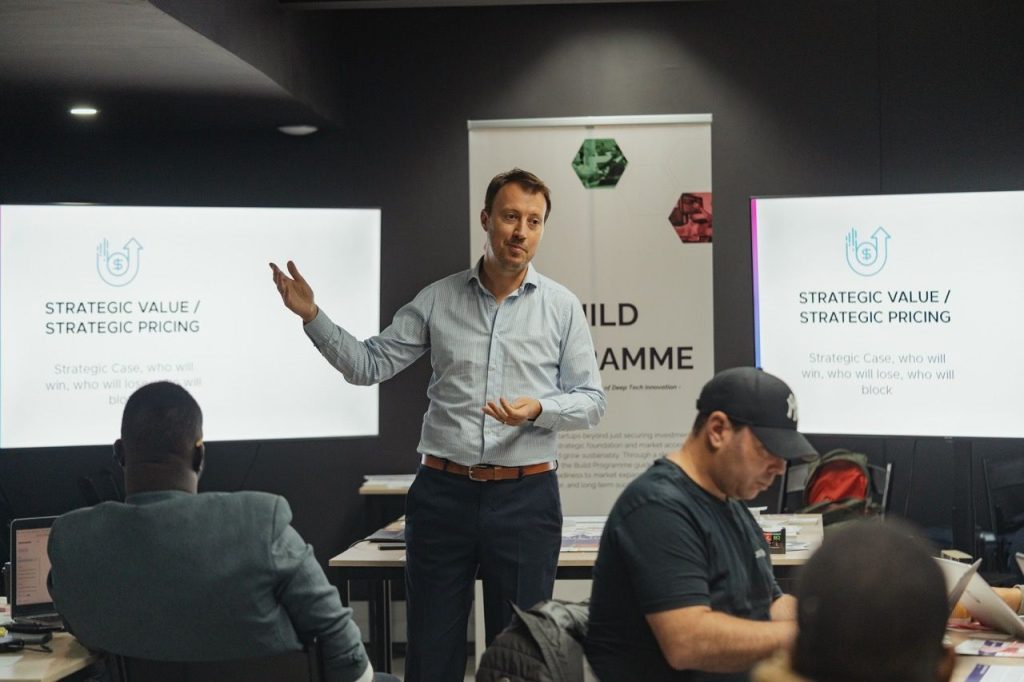
PHASE 4: FLY — Mastery, Flow & Contribution
The Paradox of Effortlessness
Master facilitators create unseen structure and invisible support, making profound learning look effortless. This looks like you are not working hard, because the deep work is already done. You are flowing.
Sensing and Flow
Fly level facilitators sense energy at a different resolution:
- Flow: You read the room’s rhythm. You know when to pause, when to push, when to shift.
- Energy: You notice when someone’s discomfort signals, they are at their learning edge. You hold that space.
- People: You see each person; where they are stuck, what they are ready to hear, what they need to discover themselves.
- Outcomes: You stay connected to what success looks like for this group, not what your plan says it should be.
- Relations: You build connections between participants, between ideas, between insight and action.
- Continuity: You create structures that extend learning beyond the room.
Seamless Adaptation
A Fly level facilitator can:
- Notice mid simulation that a founder is stuck on something deeper than the scenario and shift the game; accordingly, without disrupting flow
- See that the room needs different energy, pivot to an unexpected activity, and land perfectly
- Adapt a five-day program to four days without losing integrity
- Hold space for uncomfortable conversations because you are not scared of where they go
- Recognize when a participant’s struggle is the precise learning edge they need
What Deepens From Competent to Master
Competent facilitators after 12 to 18 months: Can run a program reliably. Participants learn. Energy is generally positive. You follow your design with flexibility.
Master facilitators after multiple years: Can adapt mid-session to emerging themes without losing coherence. Recognize when the “wrong” conversation is most important. Build custom programs that feel inevitable, not clever. Hold space for paradox, high challenge with high support simultaneously. See patterns across hundreds of founders and know when to break the pattern. Mentor others to find their own voice, not replicate yours.
Markers of Mastery
You know you have reached this level when:
- Clients return specifically for you, not just the program
- Other facilitators want to watch you work because they can feel the difference
- Participants leave with unexpected insights in directions they did not anticipate
- Things happen organically that you did not plan, the best conversations, the biggest breakthroughs
- Founders email you months later: “That moment in the simulation? It changed how I make decisions now.”
This is not perfection; it is mastery. Which means you are still learning. You are still amazed by what groups discover. You are still humbled by the privilege of holding space for transformation.
The Mastery Principle: You are moving from following a structure to embodying it. Expertise becomes invisible because it is so integrated into your presence.
THE REAL PATHWAY: WHAT THIS LOOKS LIKE ACROSS TIME
Here is how this journey typically unfolds:
Months 1 to 3 (LEARN): You are studying, reading, building your knowledge foundation. You are absorbing frameworks, case studies, books. You are building the library that will serve you for years. You have played the simulation yourself. You know the visual frameworks fluently.
Months 4 to 9 (RUN): You are co facilitating, gaining confidence. You lead your first full program. You make mistakes and recover. You build muscle memory. You run with different groups and contexts. You are developing your rhythm.
Months 10 to 18 (APPLY): You are designing custom programs, merging frameworks, inventing variations. You are finding your facilitation voice. You are building reputation in your ecosystem. You have had your first difficult client conversation; and you handled it.
Months 19 plus (FLY): You have internalized it all. You are flowing. You are orchestrating transformation. Other facilitators watch you to learn. Clients seek you out specifically.
But here is the truth: these are not strictly sequential. You are always doing all four. Even at Fly level, you are still learning new markets, new industries, new challenges. The difference is proportion. Early on, you are 80 percent Learn, 15 percent Run, 5 percent Apply. Later, you might be 15 percent Learn, 30 percent Run, 30 percent Apply, 25 percent Fly.
COMMON STUMBLING BLOCKS & HOW TO RECOVER
In Learn Phase: Paralysis by Infinite Content
The Problem: You convince yourself you need to read fifteen more books, study fifty more canvases, master every framework before running anything. You have been studying for 12 months and still feel unprepared.
Recovery: Read three foundational books; pick Venture Deals, Zero to One, and The Lean Startup. Spend two weeks on visual frameworks. Then run something; with friends, with a mentor watching. Learning accelerates when you have a context. You learn faster by doing than by additional studying.
In Run Phase: Over Scripting Due to Anxiety
The Problem: You prepare so heavily; seventeen pages of notes, exact timing for each activity, scripted transitions; that you cannot be present. You are locked into your plan. The room is trying to teach you something, but you are following your agenda.
Recovery: Prepare your opening and know your three key transitions. Get clear on the principles driving each activity, not the exact words. Then let the room teach you. Preparation creates safety; rigidity creates brittleness. The best facilitators hold their plan lightly.
In Apply Phase: Overcomplicating Customization
The Problem: You are so excited about merging frameworks that you layer OKRs, Jobs to Be Done, Lean Canvas, and three other models on top of Scale Up. The core experience drowns in complexity. Clients are confused. Outcomes suffer.
Recovery: One primary framework; Strategytools. One supporting framework; OKRs, or Lean Canvas, or Jobs to Be Done; pick one. Then let simplicity be your advantage. Complexity cannot compete with clarity.
In Fly Phase: Losing the Edge Through Complacency
The Problem: You have run hundreds of programs successfully. You are comfortable. You stop experimenting. Your programs become rote. You are no longer learning.
Recovery: Each year, intentionally try one novel approach, even if it fails. Mentor someone completely new to see facilitation through fresh eyes. Go observe a master facilitator in a completely different context; design thinking, Liberating Structures, executive coaching. Growth is a choice, not an accident.
GETTING STARTED: YOUR FIRST STEPS
If this resonates, your first action is simple: pick one book from the Learn phase reading list. Start with Venture Deals or Zero to One. Read it with curiosity and a notebook; mark the passages that surprise you.
Then find someone; a founder, a colleague, an entrepreneur in your network; and run a scaled down strategy session. Do not wait for perfection. Facilitate one conversation. Ask them for honest feedback. Do it again.
Facilitation mastery is built through repetition, feedback, and the willingness to be uncomfortable. The question is not “Am I ready?” It is “Will I commit?” The pathway becomes clear when you are already walking it.
WHAT THIS REQUIRES OF YOU
Let me be direct. This is not a certification you can buy or a course you can complete in eight weeks. This is a commitment to becoming someone who can hold transformational space for entrepreneurs making the hardest decisions of their careers.
It requires:
- Deep Study: Not surface level familiarity, but genuine knowledge you have integrated into how you think.
- Regular Practice: You cannot develop facilitation skills without facilitating. Minimum twice monthly during your Run phase.
- Honest Feedback: From mentors, peers, participants, and your own ruthless self-reflection. The willingness to be wrong and adjust.
- Continuous Improvement: Each program teaches you something. You must be hungry to learn from every experience, even the ones that go sideways.
- Genuine Investment in the Ecosystem: Not as a stepping stone to something else, but as something you deeply care about.
- Vulnerability: The willingness to learn in public, to not have all the answers, to say “I do not know” when you do not, and to be humbled by what groups discover.
- Time: This takes 18 to 24 months of deliberate practice to reach Apply phase. Fly phase? Another year or more of continuous deepening. There are no shortcuts.
The cost is not just money. It is time, attention, and genuine commitment. But the reward is joining that rare class of facilitators who reshape founder journeys, teams, and entrepreneurial ecosystems; one breakthrough at a time.
ABOUT THE AUTHOR
Enrico Maset facilitates the moments when founders, teams, and entrepreneurial ecosystems see more clearly. From Blue Tech, Clean Tech, Climate Tech, and Agro Tech cohorts at Katapult, Deep Tech with Savant in Cape Town to early stage incubators like WeAreFounders in Brussels and ecosystem development initiatives in Lebanon, North Macedonia, and Serbia, he has designed learning experiences for hundreds navigating their most complex decisions. His work includes teaching clean technology entrepreneurship at ESCP Berlin and mentoring AI plus Impact scale ups through Inco – Social Tides. He bridges entrepreneurship, visual strategy, and the craft of transformation. He continues to ask the question that drives his facilitation: “How can we create the conditions for genuine breakthrough?”
More info on my early journey with Strategytools.io: https://www.strategytools.io/case-studies/uncover-an-entirely-new-business-area/
WHAT THIS ARTICLE PROVIDES
This framework is not borrowed theory. It emerges from over a decade of facilitating, mentoring facilitators, and observing what separates program managers from transformative leaders. The four phases work because they honour both the discipline required: deep learning, consistent practice; and the emergence required: flow, presence, adaptation.
You now know the path. You have seen what it looks like at each phase. You understand this is not a quick credential; it is a progression toward mastery that demands serious commitment.
The question remains: Are you willing to commit to this journey?
EXTRA ADDITION: How many runs does it takes to become a ScaleUp master facilitator?
I’d say you need to perform:
▶️ 20 times Learn phase, light version.
I recommend a casual context first, shorter runs and building towards an audience of entrepreneurship operators.
▶️ 10 times Run phase, full version.
I recommend at least 5 co-runs with experienced facilitators
▶️ 20 times Apply phase, full version.
I recommend you play with the program design, and lead multiple co-facilitators in your sessions.
▶️ After 50+ you can consider yourself at Master level
Beware of complacency and keep on pushing the programs to be as relevant and actionable as possible
Disclaimer:
This article has been written with Human led, Machine oversight collaboration. Models used were: Claude Sonnet 4.5 and Perplexity Comet browser. For reference on Human-Machine references please check: https://www.dubaifuture.ae/hmc