
Written by Chris Rangen, advisor, faculty, investor
Written through the lens of Dr. Layla Al-ha-Mansouri, Founder & CEO, HealthSyncz MENA With insights from: Tariq E. Hassan, General Partner, Desert Capital. The people and companies are fictional for the purpose of this article.
It’s 2:47 AM in Dubai, and I’m staring at my laptop screen, trying to figure out why my board meetings feel like I’m pushing a boulder uphill. We just closed our Series A—$8.5 million from Desert Capital and two regional co-investors. Our digital health platform is processing 50,000 patient consultations monthly across the UAE and Saudi Arabia. The business is working. The team is incredible. But somehow, our quarterly board meetings leave me drained rather than energized.
Then it hit me.
I was running a Low-Performing Board while trying to build a world-class company.
The Wake-Up Call at INSEAD
During my MBA at INSEAD, Professor Jeffrey spent an entire module on corporate governance. At the time, buried in case studies about Carrefour and Schneider Electric, I thought: “This is interesting, but I’m building a startup. I’ll worry about boards later.”
That was naive.
What I didn’t realize then—but understand viscerally now—is that your board isn’t just a compliance requirement or a necessary evil that comes with institutional funding. Your board can be your secret weapon. Or it can be the anchor that prevents you from reaching escape velocity.
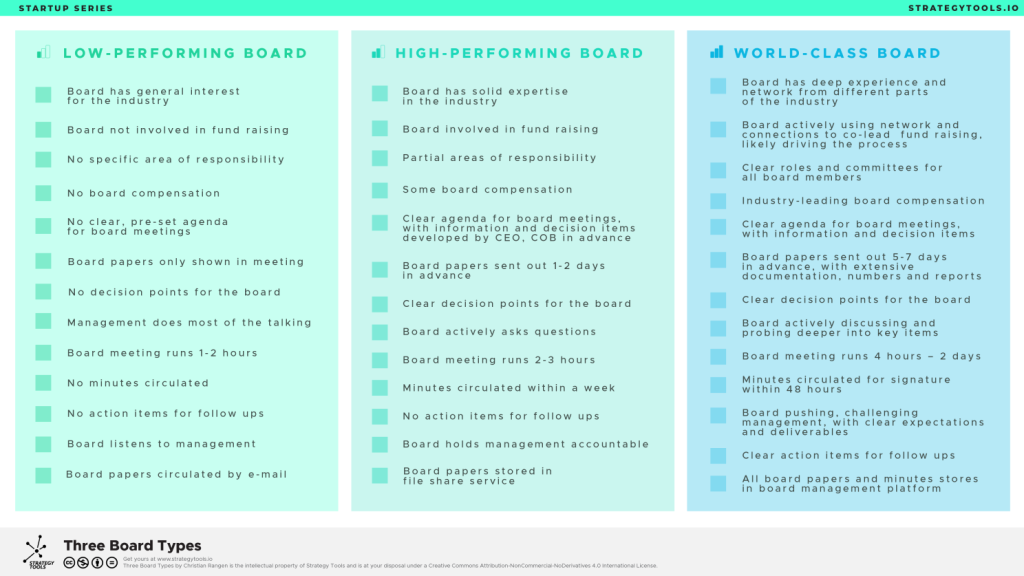
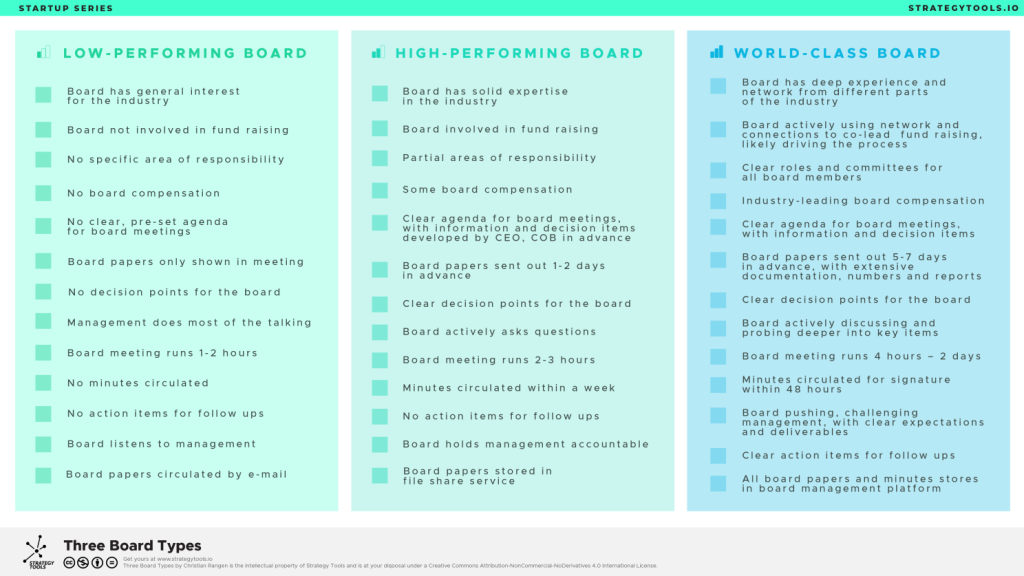
The canvas sitting on my desk now (courtesy of Chris Rangen, CEO at Strategy Tools) breaks it down into three distinct types: Low-Performing Board, High-Performing Board, and World-Class Board. Looking at it honestly, we were solidly in category one. And that needed to change.
Low-Performing Board: Where Most MENA Founders Start
Let me be brutally honest about where we were six months ago.
Our board had “general interest” in healthtech. One member had worked in telecoms, another in real estate development. Smart people, successful careers, but no specific expertise in digital health, no understanding of two-sided marketplace dynamics, and certainly no experience navigating MENA’s fragmented regulatory landscape for medical services.
Board meetings? We’d send out papers the morning of the meeting—sometimes during the meeting. I’d spend 90 minutes presenting (read: defending) every decision we’d made in the previous quarter. The board would listen politely. Management did most of the talking. We’d wrap up in 90 minutes, no clear action items, no minutes circulated.
And critically: the board wasn’t involved in fundraising. When we started our Series A process, I was on my own, cold-emailing VCs across the region, getting introductions wherever I could find them.
Sound familiar?
Tariq’s perspective (Desert Capital):
“When we see this pattern during diligence, it’s a red flag. Not a deal-breaker, but a signal that the founder hasn’t built the infrastructure for scale. A Low-Performing Board indicates one of two things: either the founder doesn’t understand governance, or they’re afraid of accountability. Both are fixable, but they need fixing before we write the check.
The MENA ecosystem has a specific challenge here. Many first-time institutional investors—family offices transitioning to venture, successful entrepreneurs doing angel investing—bring capital but not operational board expertise. They’ve never been on a high-performing board themselves, so they don’t know what good looks like.”
The Turning Point: Building a High-Performing Board
The shift started when Tariq joined our board post-Series A. His first question wasn’t about our burn rate or CAC/LTV. It was: “Who else is on this board, and what does each person bring?”
That question forced me to audit not just our board composition, but our entire board operating system.
Here’s what we changed over the following quarter:
1. Recruited for Solid Expertise
We brought on Dr. Fatima Al-Rashid, former Chief Medical Officer at Saudi German Health, who’d built integrated care networks across three countries. Suddenly, we had someone who understood DHA licensing in Dubai, CCHI requirements in Saudi, and the political dynamics of hospital partnerships. Solid expertise in the industry.
2. Created Clear Responsibilities
We established three board committees: Finance & Risk, Product & Clinical Governance, and Compensation. Each board member now owns specific areas. No more diffusion of responsibility.
3. Instituted Pre-Read Discipline
Board papers now go out 72 hours in advance. Not “papers”—a proper board pack: financial dashboard, operational KPIs, strategic decision items, and a clear agenda developed by myself and our Board Chair. Each agenda item specifies whether it’s for information, discussion, or decision.
4. Got Active on Fundraising
This was transformative. When we started exploring our Series B plans, our board members made introductions to three Gulf-based VCs and two international funds with MENA practices. These weren’t cold intros—they were warm connections where our board members had invested personal credibility. The board became involved in fundraising.
5. Implemented Some Compensation
We introduced equity grants for board members. Not life-changing amounts, but enough to create meaningful alignment. When board members have skin in the game, the dynamic shifts.
Our board meetings now run 2.5 to 3 hours. The board asks real questions. They challenge assumptions. They hold management accountable. And critically: we circulate minutes within a week, with clear follow-ups and owners.
The difference? I leave these meetings energized. We make better decisions. We move faster because we’ve pressure-tested our thinking with people who’ve been there before.
Tariq’s perspective:
“The transition from Low-Performing to High-Performing Board is where we see founders level up. Layla didn’t just accept our board seat—she took the initiative to reshape her entire governance structure. That signal alone gave us confidence for follow-on investment.
In MENA, we’re still building these muscles. In Silicon Valley, founders often have board members from previous companies who model good governance. Here, we’re creating these patterns from scratch. That’s why Desert Capital runs a ‘Board Readiness’ workshop for all our portfolio CEOs within 90 days of investment. We can’t assume founders know this instinctively.”
The World-Class Board: The Aspiration
Looking at the canvas, I can see where we need to go. A World-Class Board operates at a completely different altitude.
The board members have deep experience and networks from different parts of the industry—not just clinical expertise, but regulatory affairs, government relations in multiple MENA markets, experience scaling tech platforms in emerging markets, and exits under their belt.
They’re actively using their networks to co-lead fundraising, making the critical introductions that unlock Series B and Series C rounds. When you’re trying to raise $30M+ in a region where that’s still a large round, having board members who can get you in the room with Mubadala, STV, or international funds makes all the difference.
There are clear roles and committees for all board members—no passengers, everyone contributing. Board papers go out 5-7 days in advance with extensive documentation, numbers, and reports. Meetings run 4 hours to 2 days depending on the strategic importance.
The board is actively discussing and probing deeper into key items, challenging management constructively. Minutes are circulated within 48 hours for signature, and there are clear action items with deliverables that actually get tracked quarter to quarter.
Most importantly: the board is pushing, challenging management, with clear expectations. They’re not there to rubber-stamp decisions. They’re there to make us better.
And they use a proper board management platform where all documents live, all discussions are tracked, and institutional knowledge is preserved.
Are we there yet? No. But we have the roadmap

The MENA Context: Why This Matters More Here
The MENA startup ecosystem is at an inflection point. We’re seeing larger rounds, more international capital, and rising expectations for governance and professionalism. But we’re also dealing with unique regional challenges:
Regulatory Fragmentation: Healthcare regulations vary dramatically across GCC markets. A World-Class Board with regional expertise helps navigate this.
Capital Scarcity at Growth Stage: Series B and beyond remains challenging in MENA. Having board members who can actively fundraise and make introductions isn’t nice-to-have—it’s existential.
Limited Depth of Operational Expertise: We don’t yet have the depth of experienced operators that Silicon Valley has. Building a High-Performing or World-Class Board means being creative—bringing in advisors from adjacent industries, recruiting board members from international companies with MENA experience.
Cultural Dynamics: Board meetings in MENA can sometimes default to extreme deference to founders or senior members. A High-Performing Board requires creating a culture where respectful challenge is not just acceptable but expected.
Tariq’s perspective:
“At Desert Capital, board quality is one of our key evaluation criteria during diligence. We look at: Who’s on the board? What do they bring? How do they operate? And critically—is the founder coachable on governance?
We’ve passed on deals where the business fundamentals were strong but the founder was resistant to board professionalization. That’s a massive risk at scale. Conversely, we’ve backed founders who had weaker initial traction but demonstrated exceptional ability to build governance infrastructure. Those founders tend to be the ones who successfully navigate Series B and beyond.
The MENA region is producing world-class founders. Now we need to produce world-class boards to match. That’s how we build enduring companies, not just exciting startups.”
The Practical Roadmap: Moving Up the Ladder
If you’re a founder reading this and recognizing yourself in the Low-Performing Board description, here’s how to start moving up:
Phase 1: Audit Brutally (Month 1)
- Map what each board member actually brings to the table
- Assess your current board operating system honestly
- Identify the gaps in expertise and experience you need
Phase 2: Professionalize the Basics (Months 2-3)
- Institute the 72-hour pre-read rule
- Create a standard board pack template
- Start circulating minutes within one week
- Establish clear agenda-setting with your Board Chair
Phase 3: Upgrade Composition (Months 4-9)
- Recruit one board member with deep industry expertise
- Consider creating an Advisory Board if you can’t immediately change Board composition
- Be willing to have difficult conversations with board members who aren’t contributing
Phase 4: Activate Your Board (Months 6-12)
- Create formal board committees with clear mandates
- Get your board actively involved in your next fundraising process
- Implement board member equity compensation if you haven’t already
- Start using a board management platform (we use Carta, but there are several options)
Phase 5: Build Toward World-Class (Year 2+)
- Extend board meetings to 4+ hours with deeper strategic discussions
- Institute the 5-7 day pre-read discipline
- Recruit board members with networks across multiple MENA markets
- Create a culture of constructive challenge and accountability
This isn’t quick. But it’s essential.
The Bottom Line
Nine months ago, I would have said board meetings were a necessary tax on my time. Today, I see our board as one of our most important competitive advantages.
The businesses that will win in MENA over the next decade won’t just be the ones with the best product-market fit or the strongest unit economics. They’ll be the ones with the governance infrastructure to scale through multiple funding rounds, navigate complex regulatory environments, and build institutions that outlast their founders.
That starts with your board.
So here’s my challenge to every founder reading this: pull up the Three Board Types canvas. Be honest about where you are. Then commit to moving up the ladder.
Your Series B investors will thank you. Your management team will thank you. And most importantly, your future self—exhausted from building a regional champion—will thank you.
About the heroes of this story:
Dr. Al-ha-Mansouri, is the Founder & CEO of HealthSyncz MENA, a digital health platform connecting patients with healthcare providers across the GCC. She holds an MBA from INSEAD and previously worked in healthcare strategy consulting. HealthSyncz has raised $12M to date and operates across UAE, Saudi Arabia, and Kuwait.
Tariq E. Hassan is a General Partner at Desert Capital, a Dubai-based venture capital fund focused on Series A and B investments in MENA technology companies. Prior to Desert Capital, Tariq was VP of Corporate Development at Careem and an Associate Principal at McKinsey & Company. Desert Capital has invested in 24 companies across fintech, healthtech, logistics, and enterprise SaaS.
Written by:
Chris Rangen, global strategy advisor to startups, scale ups, CEOs, VCs, Fund-of-funds and national ecosystem builders.
Want to level up your board governance?
Download the Three Board Types canvas and other governance tools at strategytools.io
Join founders across MENA who are building World-Class Boards for their scale-ups.
This article is part of the Startup Series at Strategy Tools, helping founders, investors, and ecosystem builders across MENA navigate the journey from startup to scale-up. Read more about Scale Up MENA here.