


Written by Chris Rangen, advisor, faculty, investor. Big thanks to Tiffany Bain , Dubai Future District Fund and Nitin Reen , Nuwa Capital for valuable discussion on the topic.
Your board isn’t static. It evolves as your company does.
Most founders get this wrong. They think about their board as a one-time decision, made at incorporation or when investors come in. But the reality is different. Your board should transform as you move through the founder’s journey, from that first day working out of a co-working space in Dubai Internet City to the moment you’re negotiating your Series C with regional and international VCs.
The question isn’t whether your board will change. It’s whether you’re intentional about how it changes.
Here’s how startup boards typically evolve across seven distinct stages, based on hundreds of companies we’ve worked with across MENA and globally.
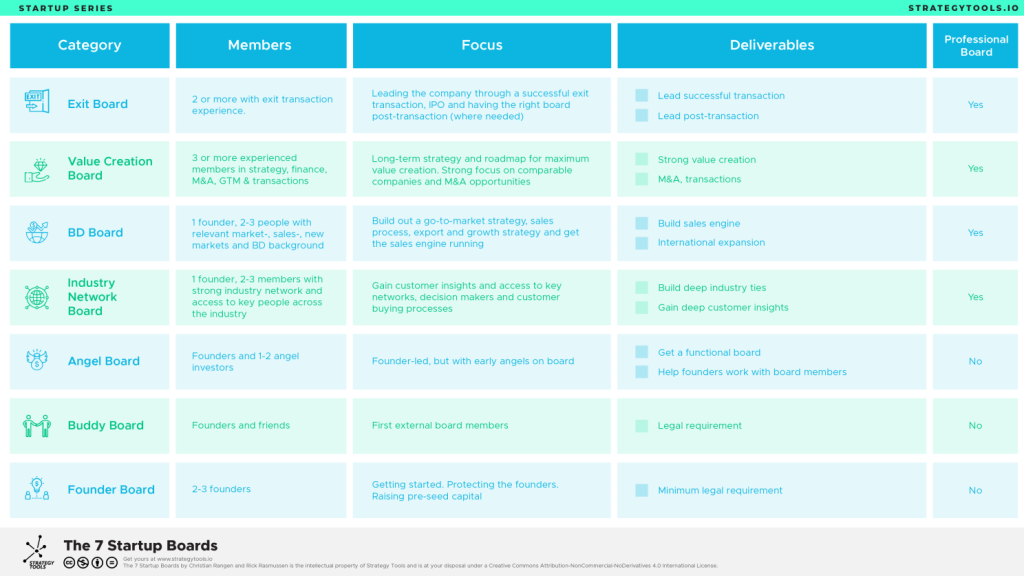
Stage 1: Founder Board
Members: 2-3 founders Focus: Getting started. Protecting the founders. Raising pre-seed capital Deliverables: Minimum legal requirement
This is where every startup begins. Just you and your co-founders, sitting around a table at AstroLabs or in5, trying to figure out if this idea has legs.
At this stage, your board is purely functional. You need one to incorporate. That’s it.
MENA Example: When Ahmed and Sara launched their B2B SaaS platform in Dubai, their first board meeting was literally a Google Doc they both edited. They were focused on one thing: getting to product-market fit. The board formalities could wait.
The mistake founders make here? Overthinking it. You don’t need elaborate governance structures when you’re still validating your idea. Keep it simple. Protect your equity. Document decisions. Move fast.See content credentials
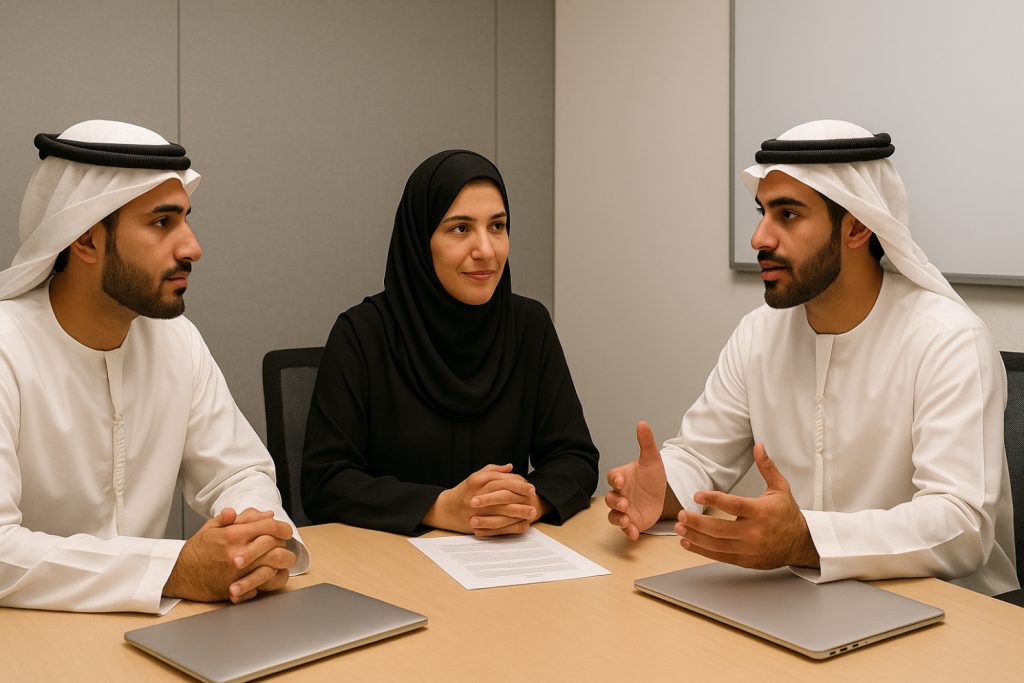
Stage 2: Buddy Board
Members: Founders and friends Focus: First external board members Deliverables: Legal requirement
You’ve raised a small friends and family round. Maybe AED 200K from an uncle who believes in you, or from that former colleague who’s doing well in tech.
Now you might get your first external board members. They’re well-meaning. They care about you. But let’s be honest: they’re probably not adding strategic value yet.
MENA Example: A Dubai-based edtech startup brought on the founder’s former university professor and a successful entrepreneur from their network. These board members provided encouragement and opened a few doors, but didn’t fundamentally change how the company operated.
This stage is transitional. You’re learning what a board can do. You’re practicing the mechanics of board meetings, updates, and governance. It’s training wheels.
The risk? Staying here too long. As you grow, you need strategic horsepower, not just friendly faces.
Stage 3: Angel Board
Members: Founders and 1-2 angel investors Focus: Founder-led, but with early angels on board Deliverables: Get a functional board. Help founders work with board members
You’ve raised your first institutional-ish money. Maybe from Dubai Angel Investors, Riyadh Angels, or a group of seasoned operators who’ve been where you are.
This is where boards might start getting interesting. Many founders still don’t set up board at this stage. Maybe they should?
MENA Example: A Bahraini fintech startup brought on two angels after their pre-seed round: a former bank executive with deep connections in the GCC financial sector, and a serial entrepreneur who had built and exited a payments company. Suddenly, board meetings became strategy sessions. The angels helped the founders think through regulatory challenges, introduced them to potential enterprise customers, and pressure-tested their go-to-market assumptions.
At this stage, your board should help you professionalize without bureaucratizing. You’re learning to work with people who have put money into the startup, but aren’t running the day-to-day.
The founders still drive the agenda. But now you have advisors who’ve actually done this before.
Stage 4: Industry Network Board
Members: 1 founder, 2-3 members with strong industry network and access to key people across the industry Focus: Gain customer insights and access to key networks, decision makers and customer buying processes Deliverables: Build deep industry ties. Gain deep customer insights
You’re post-seed, maybe approaching Series A. You’ve validated your product. Now you need to scale distribution. Simply, you need access to more customer prospects.
This is where industry-specific expertise becomes critical.
MENA Example: A Saudi healthtech company building a hospital management platform brought on the former CIO of a major hospital group and a healthcare venture partner. These board members didn’t just advise—they made introductions. Within six months, the startup had pilots running in three major hospital systems across the Kingdom. The board members understood the procurement cycles, the decision-making hierarchies, and the political dynamics inside large healthcare institutions.
At this stage, your board becomes a business development engine. Every board member should be able to pick up the phone and get you in front of customers, partners, or ecosystem players that would otherwise take you months to reach.
The focus shifts from “help us figure out what to build” to “help us get to the people who will buy it.”
Stage 5: BD Board (Business development board)
Members: 1 founder, 2-3 people with relevant market, sales, new markets and BD background Focus: Build out a go-to-market strategy, sales process, export and growth strategy and get the sales engine running Deliverables: Build sales engine. International expansion
You’ve got product-market fit. You’ve got early traction. Now you need to build a machine.
This board is about scaling what works. At this stage, your board should be commercially minded, with strong ties into buyers at scale.
MENA Example: An Egyptian logistics-tech startup that had proven their model in Cairo brought on board members with experience scaling across emerging markets. One had built sales teams across Africa for a major tech company. Another had led international expansion for a regional e-commerce player. Together, they helped the founders build a repeatable sales playbook, structure their regional expansion into Saudi Arabia and the UAE, and avoid the classic mistakes of scaling too fast without infrastructure.
At this stage, board meetings focus on metrics. Unit economics. Customer acquisition costs. Sales cycle length. Pipeline coverage.
Your board should be challenging your assumptions about what’s working and what’s not. They should be pattern-matching against companies that have scaled successfully, and warning you about the ones that didn’t.
Stage 6: Value Creation Board
Members: 3 or more experienced members in strategy, finance, M&A, GTM & transactions Focus: Long-term strategy and roadmap for maximum value creation. Strong focus on comparable companies and M&A opportunities Deliverables: Strong value creation. M&A, transactions
You’re Series B, maybe Series C. You’ve built a real business. Now you’re optimizing for exit optionality. But first, scaling and value creation.
This board thinks in terms of enterprise value, strategic acquirers, and market positioning.
MENA Example: A UAE-based mobility startup that had raised $30M brought on board members who had led M&A at major automotive companies and growth equity investors who understood the regional exit landscape. They helped the founders position the company for either a strategic acquisition by a major regional conglomerate or an IPO on the Abu Dhabi Securities Exchange. The board ran scenarios on different exit paths, connected the founders with investment banks, and helped them think about how each strategic decision impacted valuation multiples.
At this stage, every board discussion has an eye on the end game. How do we maximize value for shareholders? What comparable companies should we benchmark against? What strategic moves make us more attractive to acquirers or public markets?
The founders are still driving the business, but the board is stress-testing the long-term strategy against real market opportunities.
Stage 7: Exit Board
Members: 2 or more with exit transaction experience Focus: Leading the company through a successful exit transaction, IPO and having the right board post-transaction (where needed) Deliverables: Lead successful transaction. Lead post-transaction
This is the stage where the company goes from private to public ownership. You are rapidly growing up. You’re actively in process, whether that’s an IPO, a strategic sale, or a major secondary transaction.
MENA Example: When Careem prepared for its $3.1 billion acquisition by Uber, the board included members who had navigated major exits before. They understood the complexities of cross-border M&A, regulatory approval processes across 13 countries, employment transitions, and the negotiations with a strategic acquirer. The board helped the founders and executives think through not just the transaction itself, but what came after—the integration, the earnouts, the team transitions.
At this stage, your board should have been through this movie before. They know what a good deal looks like. They know when to push and when to walk away. They understand the legal, financial, and human complexities of major transactions.
This isn’t the time for learning on the job.

The Pattern
Look at the progression. Early-stage boards are about governance and legitimacy. Middle-stage boards are about access and execution. Late-stage boards are about value and exit.
The mistake most founders make? Having the wrong board for their stage. Keeping buddy board members when you need industry access. Keeping angel investors on the board when you need M&A expertise. or, in many cases, not having a board at all.
Your board should evolve as deliberately as your product, your team, and your strategy.
Each transition is an opportunity to upgrade the strategic capacity of your company. To bring in the expertise, network, and pattern recognition you need for the next phase.
Most importantly, your board should reflect where you’re going, not where you’ve been.
A great board will focus on where the company needs to be in two years, not just where it is today. Three questions for founders building their boards
1. Does your current board composition match your current stage and immediate challenges? If you’re scaling go-to-market but your board is full of product people, you’ve got a mismatch.
2. What expertise will you need in 12-18 months that you don’t have on your board today? Board changes take time. Start thinking about your next board evolution before you desperately need it.
3. Who on your current board should you transition off to make room for new capabilities? This is the hardest question, but also the most important. Building the right board sometimes means making tough decisions about who no longer fits the company’s needs.
This article is part of the Startup Series at Strategy Tools, helping founders, investors, and ecosystem builders across MENA navigate the journey from startup to scale-up. Read more about Scale Up MENA here. Thanks to Scott Newton and Rick Rasmussen for extensive discussions on startup board qualities.