

Are you a founder raising capital? These are the top ten questions I ask founders.
I just got off a call. Great founder. Raising a strong Series A. Except, maybe not.
The momentum was not quite there. The investor prospects were starting to dry up. Christmas was approaching (there’s always an excuse for investors wanting to avoid saying “no”).
In fact, I’m having a lot of these calls. Getting towards the end of the year. A lot of founders are trying to close out funding rounds, trying to avoid dragging them into the new year.
Here are the top ten questions I ask founders raising capital right now.
1. Who’s on your fundraising team?
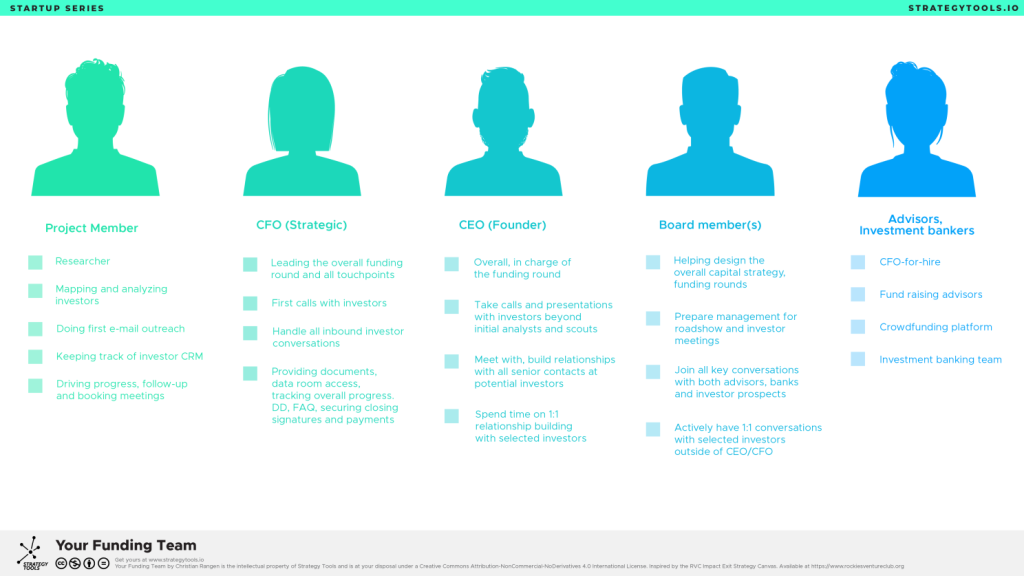
Raising capital is a team sport. It’s not just the CEO on endless Zoom calls. Every successful raise I’ve seen has a clear division of roles and responsibilities across the founding team, board, and advisors.
Your Project Member handles the research—mapping and analyzing investors, doing the first e-mail outreach, keeping the CRM updated, and driving progress through follow-ups and booking meetings.
Your CFO (Strategic) leads the overall funding round and all touchpoints. They take the first calls with investors, handle all inbound conversations, and provide documents, data room access, and track progress through DD, FAQ, securing closing signatures and payments.
Your CEO (Founder) is overall in charge of the funding round. They take calls and presentations with investors beyond initial analysts and scouts, meet and build relationships with senior contacts at potential investors, and spend time on 1:1 relationship building with selected investors.
Your Board Members help design the overall capital strategy and funding rounds. They prepare management for roadshow and investor meetings, join key conversations with advisors, banks, and investor prospects, and actively have 1:1 conversations with selected investors outside of CEO/CFO.
And don’t forget your Advisors and Investment Bankers—CFO-for-hire, fundraising advisors, crowdfunding platforms, and investment banking teams can all play crucial roles depending on your round size and strategy.
If you can’t clearly articulate who does what in your fundraising team, you’re already behind.
2. How many investors have you mapped (long list)?
When I ask founders this question, I often hear “about 50” or “maybe 100.” That’s not enough.
During the Mapping phase—which should begin 12 to 24 months before you need the capital—you should be building an investor database of 200 to 1,000+ investor prospects. You should be analyzing and selecting your Top 100, Top 30, and Top 10. You should be identifying all blocked investors (those who’ve invested in competitors, have conflicting interests, or simply aren’t a fit).
The best founders I work with treat investor mapping like a sales pipeline. Because that’s exactly what it is.
3. How are you using your investor CRM—honestly?
Most founders have some kind of spreadsheet. Few have a proper CRM system for their investors. Even fewer actually use it consistently.
Your investor CRM should track every touchpoint, every meeting, every follow-up.
It should tell you when you last contacted each prospect, what the next action is, and where they sit in your pipeline. You should be updating it continuously throughout the process.
If your CRM is a mess, your fundraise will be too.
The best founders? They give me access to their investor CRM, no questions asked. 4. How many investor prospects would you count as ‘strong relationships’?
Here’s where the rubber meets the road. It’s one thing to have a long list. It’s another to have developed real relationships with your top prospects.
During the Preparations phase—6 to 12 months before your raise—you should be developing early relationships with your top 100 investor prospects. You should be identifying your top 100 lead prospects and developing targeted investor profiles.
The founders who struggle are the ones who start building relationships when they need the money. The ones who succeed started building those relationships a year ago.
5. Walk me through your key metrics, both absolute and Y-o-Y growth
Investors want to see traction. They want to see momentum. If you can’t walk me through your key metrics—revenue, user growth, unit economics, and critically, year-over-year growth—in under two minutes, we have a problem.
You need to set your KPIs, metrics, and revenue story before you start serious investor conversations. These should be crystal clear in your materials phase.
Know your numbers cold. Investors will.
The best founders can easily articulate, $1,5M ARR, growing at 18% Month-over-Month, with a $14 CAC/forecast $900 LTV, 3% churn, 6.000 SME customers, 14 enterprise customers. Total pipeline of 28.000 prospects. Given our accelerated growth, will hit $100M ARR in 38 months.
6. Can you show me your Outcome Canvas on this round?
What does success look like for this round? And I don’t just mean “we raised the money.”
I mean for your investors, your current lead investors and their probable outcome. This is core to their investment decision – and you need to help them bring their decision to a resounding yes.
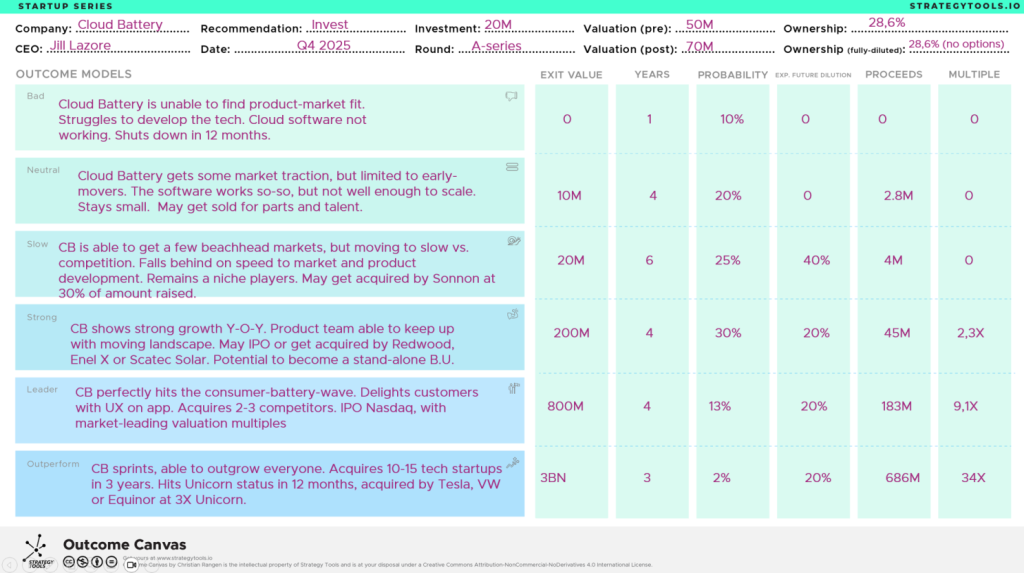
Founders who can't articulate their likely investor outcomes often end up with outcomes they didn't want.7. Where can I find your six decks?
Yes, six. Different investors need different materials at different stages.
You need your one-pager, your pitch deck, your meeting deck, your teaser deck, your full investor deck and your long deck. Each serves a different purpose in the investor journey. During the Materials phase—4 to 6 months out—you should be developing your one-pager plus the five other investor decks, setting up Docsend plus investor FAQ, developing your data room, and recording your pitchdeck Loom. (Read more about the Six decks you need here)
If you’re scrambling to put together materials while in active conversations, you’re already too late.
8. How many investor meetings are you running—every week?
During the active Process phase—which typically runs 1 to 4 months—you should be targeting up to 25 investor meetings per week. Yes, per week.
You need to run all investor meetings over a limited number of weeks, create momentum, and use power questions to balance power dynamics. The goal is to map out your top investors’ decision-making process and timeline while updating your CRM continuously.
Fundraising is a sprint, not a marathon. If you're doing 3 meetings a week, you're not fundraising—you're just having coffee.9. Talk me through how you are securing five competing term sheets—or more?
One term sheet is not a negotiation. Two is barely better. You need to be targeting five or more competing term sheets.
This means you need to secure multiple possible lead investors. You should be receiving and negotiating on multiple term sheets simultaneously.
The founders with the best outcomes are the ones with the most options. Competition creates leverage.
10. What’s the timeline and probability to close the round?
Finally, I want to know your honest assessment. When do you expect to close? And what’s the probability you actually will?
The Closing phase will take about a month, maybe two. You finalize legal documents, close the round, settle legal documents, receive invested amounts, and potentially combine new equity with debt or soft-funding. It takes time.
Be honest with yourself. And be honest with me. What’s really your timeline?

Now, Prepare for the Next Round
Here’s what most founders forget: the moment you close one round, you’re already preparing for the next one. Media and announcements follow closing, and then the cycle begins again.
The Funding Journey is not a single event. It’s a continuous process that requires deliberate planning, systematic execution, and relentless relationship building.
So, founder—how would you answer these ten questions?
Finally, the most important question, how can I help?
This article is a part of the upcoming report Fundraising Success: a playbook for global founders raising capital. Coming in 2026. Pre-register today.