

The Story Of Scaling Leo Bank From Idea To Exit In The Middle East. Part III: Growth Stage (Series C,d To Exit)
A three-part story on scaling a fintech in the Middle East, written as a part of the upcoming launch of Scale Up MENA, august 2025. Read part I: the early days (start up, seed): and part II: scaling up (Series A,B)
“What Does Your Outcome Canvas Look Like?”, The Question From The Investment Team At Future Fund Oman Had Taken The Founders Aback. Outcome? Canvas?
In exploring a lead candidate for the Series D, it was clear that the conversations, the expectations and the strategic thinking was going to be a big step up from the conversations they had back at Series A. “Are you aiming to list in Riyadh, London or the US?”.
“Do you have the exit paths ready in your data room?”, the associate had asked over and over again. The truth was, they did not. Not yet.
Series C Led By PIF
Six months earlier.
“Another unicorn minted in MENA”, read the LinkedIn posts, as Leo Bank hit the coveted $1BN valuation mark.
The Series C had come together pretty quickly as well. Public Investment Fund had gotten introduced via the team at Wamda Capital. There was a clear strategic match, and PIF was incredibly supportive on backing a strong growth story.
PIF had proposed a $100M round or a mega $500M round, for 25% ownership. The $500M was simply too much capital, and the board decided to go for the $100M for 10%. There were some demanding terms, and it took a few weeks to negotiate out some of the most challenging terms, but they got it done.
Cap Table Post Series C, With PIF
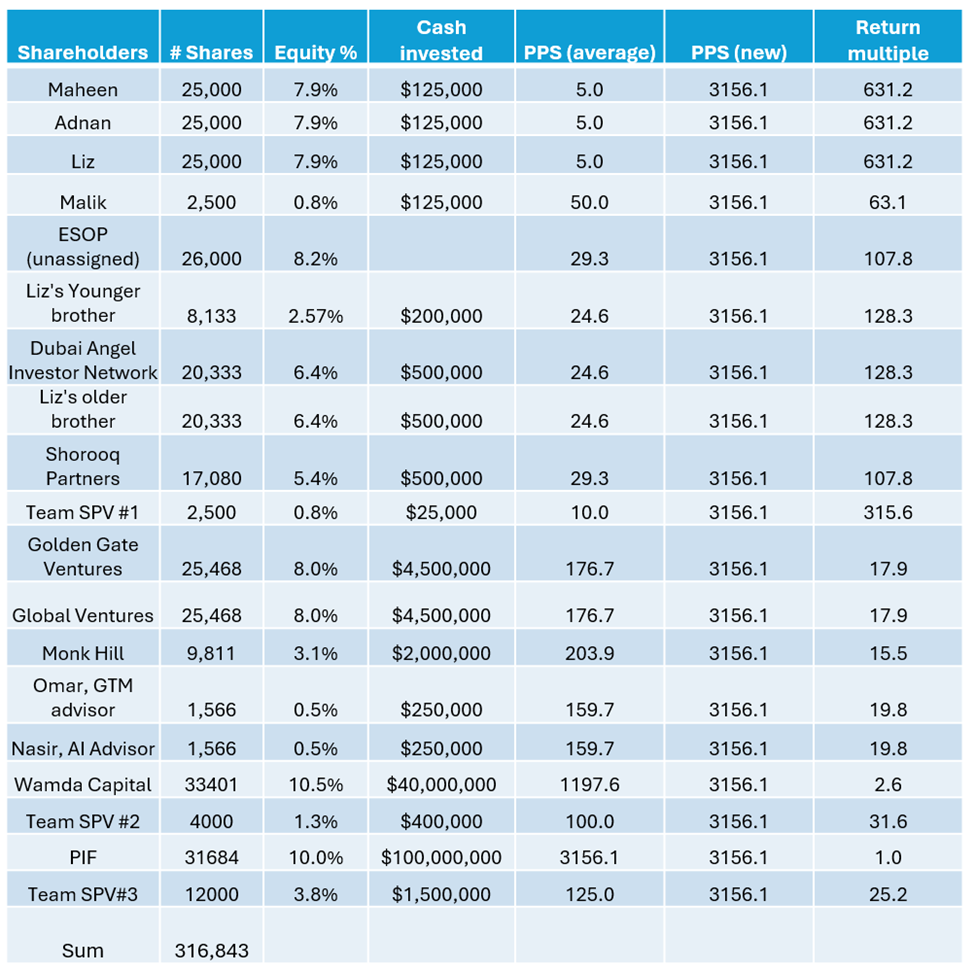
Cap table post Series C, PIF’s team also corrected the new reality for Malik’s PPs, at $50,- effective
Market Expansion, Market Expansion
The new capital from PIF had been used for market expansion, both to strengthen the position across MENA as well as launching in key, new markets like Singapore, India and Pakistan. “Rest is not an option, we need to grow, grow, grow”, was the new mantra across the growth teams.
Dealing With Massive Scaling Challenges
“Being a seed company is easy, trying to scale is a whole different game”, Liz was getting worn down. Leading the new market expansion, she was the one spearheading all market- and revenue work.
Her role as CRO had taken on a whole new level of complexity. Managing 590 people, she realized she no longer could work the way she and her teams had so far. New structures, processes and procedures were needed, and needed fast. “At this pace, I am going to run into a brick wall”, she had shared with Adnan and Maheen during one of their 5 am morning runs.
Closing Series D With Future Fund Oman
The first introduction to Future Fund Oman had come through their board member from PIF, Omar. Having worked in multiple family offices and now in a senior investment role at PIF, he was deeply connected across the region. Future Fund Oman, was in Omar’s view, the perfect growth-stage investor for Leo Bank.
Over a series of meetings, Adnan and the team came to understand the methodology and investment process Future Fund Oman applied. The Outcome Canvas, or Outcome scenario analysis, or just sensitivity analysis, this was a must-have for the 12-person investment team at Future Fund Oman.
It took longer than expected, but finally both sides arrived at an Outcome assessment they could buy into. A mere 3% chance of achieving the Outperform scenario, it was a tall order for Adnan and the team to scale to become a top performing investment for FFO.
Future Fund Oman, in the end, signed onto the investment papers to lead both Series E and Series D, granted the company was able to hit the revenue milestones in the growth plan. “Of course, we’ll hit them”, Liz said as she put her team to work.
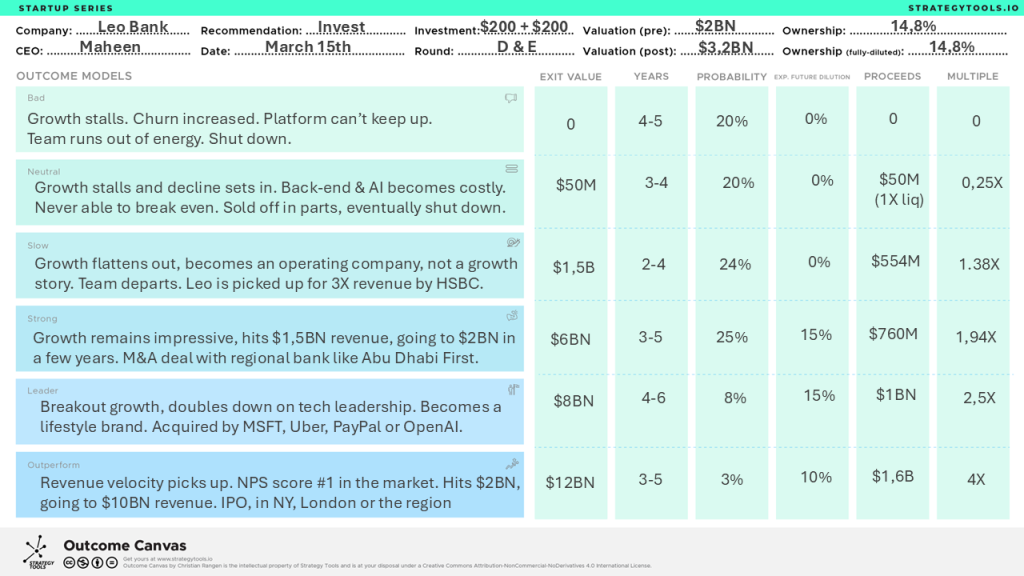
Outcome Canvas, for Leo Bank. In Scale Up MENA! Masterclasses participants learn to apply the Outcome Canvas and start working on crafting a strategy and narrative around investor returns.
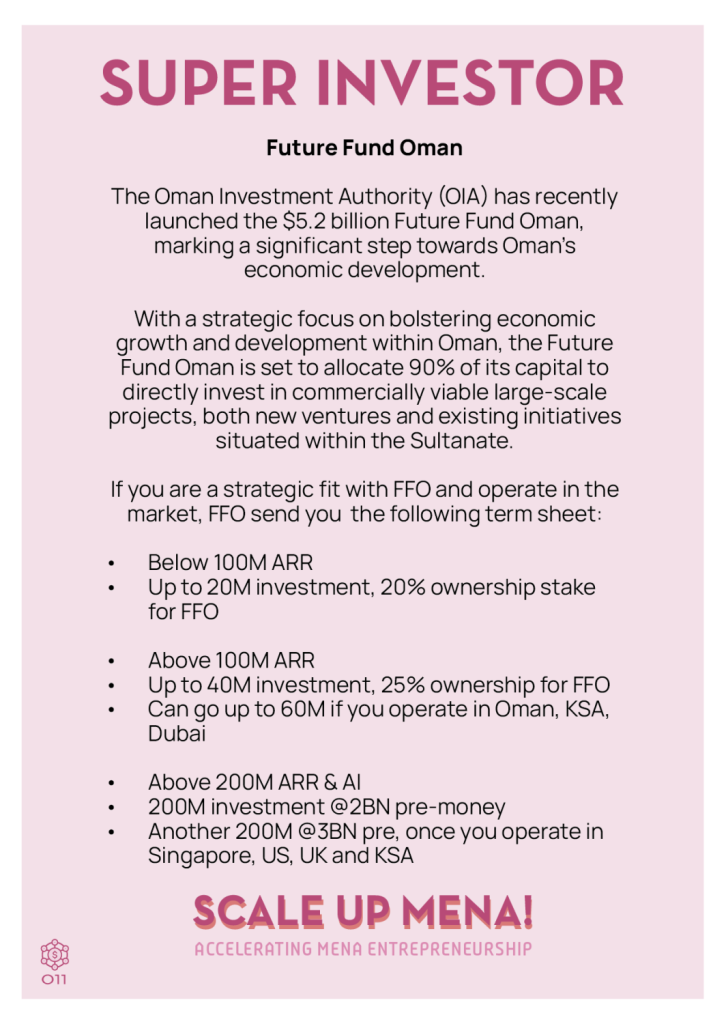
Future Fund Oman was eager to do a $200M round at $2BN, then roll into another $200M @3BN, once the commercial milestones were hit.
Cap Table Post Series D With FFO
Cap table post Series D, PIF and FFO both with 9,1%, while Wamda still has the highest equity post at 9,6%.
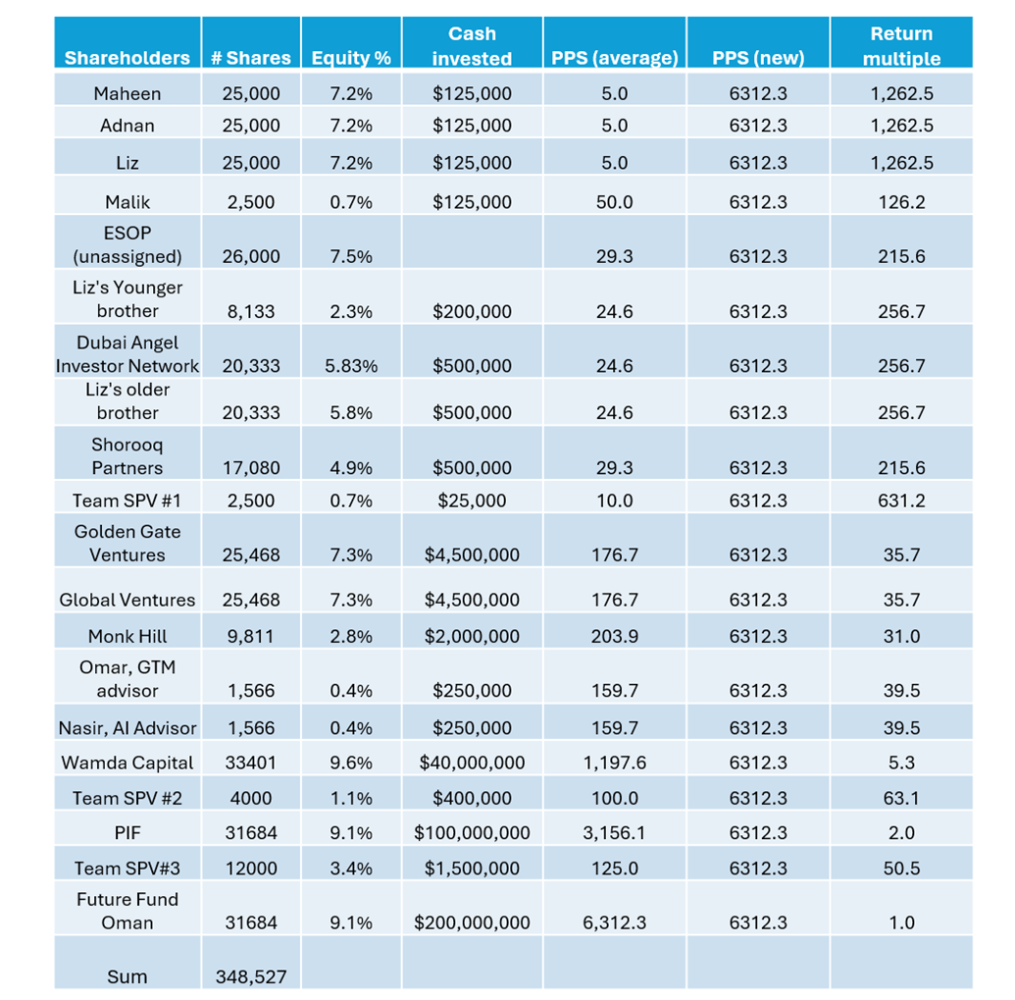
Cap table post Series D with FFO coming in for the first round.
Cap Table Post Series E With FFO
With the Series E financing, taking the Leo Bank to $3,2BN post-money valuation, the increase in valuation and return multiple were really starting to kick in. While still completely unrealized gains, the early investors were looking at a 350X return – and still sizeable ownership in
“Leo has the potential to become one of the region’s breakout winners”, members of the Dubai Angel Investor Network discussed in their annual investor summit.
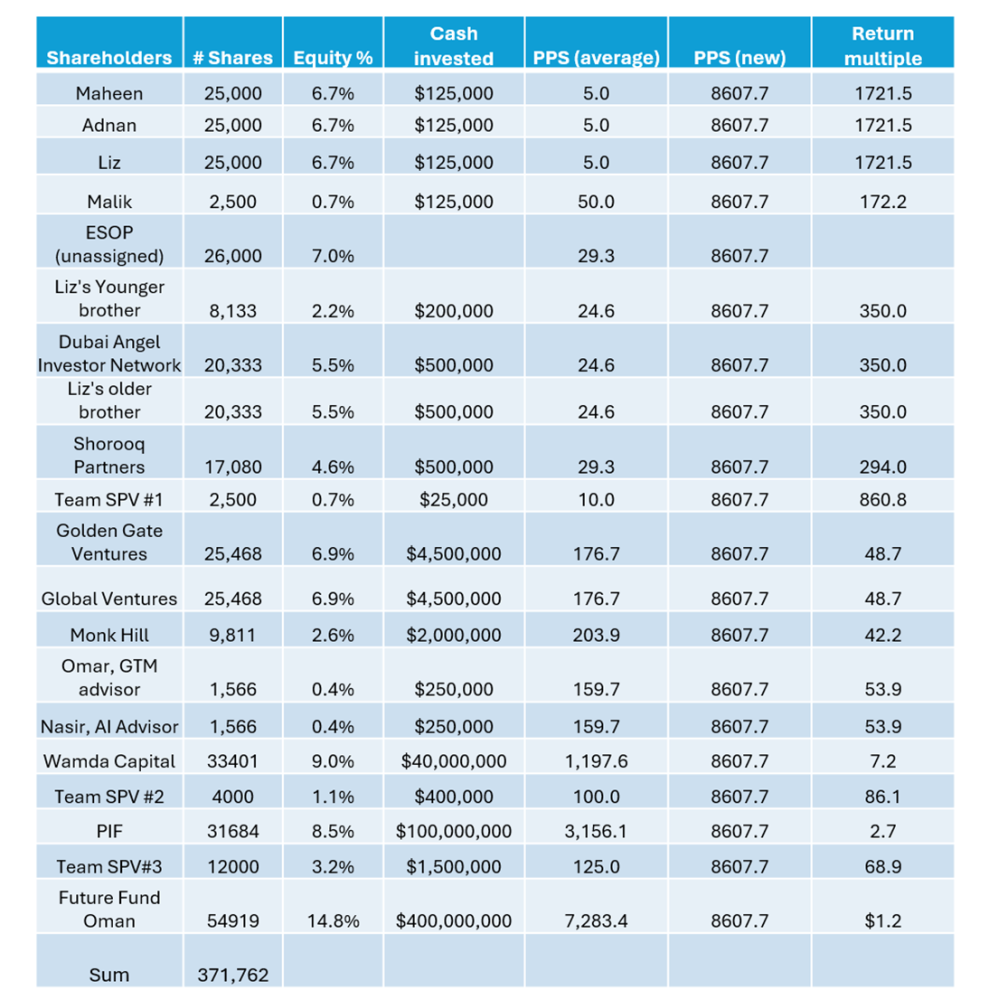
Cap table post Series D with FFO taking the second round, for a total investment of $400M.
Post Series E, Future Fund Oman increase their stake to 14,8%, becoming the leading investor in Leo Bank.
Rebranding, Product Expansion
“It’s time to launch the next version of Leo”. The product team had worked on this for nearly nine months. The next version of the product roadmap was an ambitious step up. “So, so much more than just a bank. We are becoming the digital backbone for 100M people in MENA”, Basil, the new Chief Product Officer had stated. With backgrounds from Twitter and WhatsApp, he had seen what it took to develop scalable digital products that people loved.
“Also, with the new product launch, we are doing a rebrand. From now on, it will simply be Leo”, Maheen and Liz announced at the monthly all-hands meeting. Growing, with over 4.000 team members, the all hands were now more digital than ever, but also a key part of maintaining the team culture and cohesion as they grew at breakneck pace.
Exit Paths
“How do we create liquidity and exits for investors and founders?”, the question had been circulating in the finance team for some months now. It was the angels from DAN who had first brought it up. One of them, Sanjana Raheja had been an exceptionally active angel. As an active member of the ecosystem, Sanjana, or just San, had been coaching the team for months now. “I’d like to see some more non-obvious exit pathways that come in”, She had asked.
Using the GP Exit Paths, from Strategy Tools, San had provided the investment team with a simple, visual structure to start mapping out more exit paths. “Not all exits are exits”, San kept saying. “We need to think about investor liquidity throughout the founder’s journey, not just as a possible big bang in 5-10 years time”. San was a trusted advisor to both startups, scale ups and emerging fund managers, known for her depth and reflective thinking about creating new paths to liquidity in the region.
Under San’s guidance, and working with Michael at Golden Gate Ventures, the investment team developed the GP Exit Paths, taking the view of GGV. GGV was coming towards the end of their fund lifetime, and access to disciplined liquidity was becoming a thing.
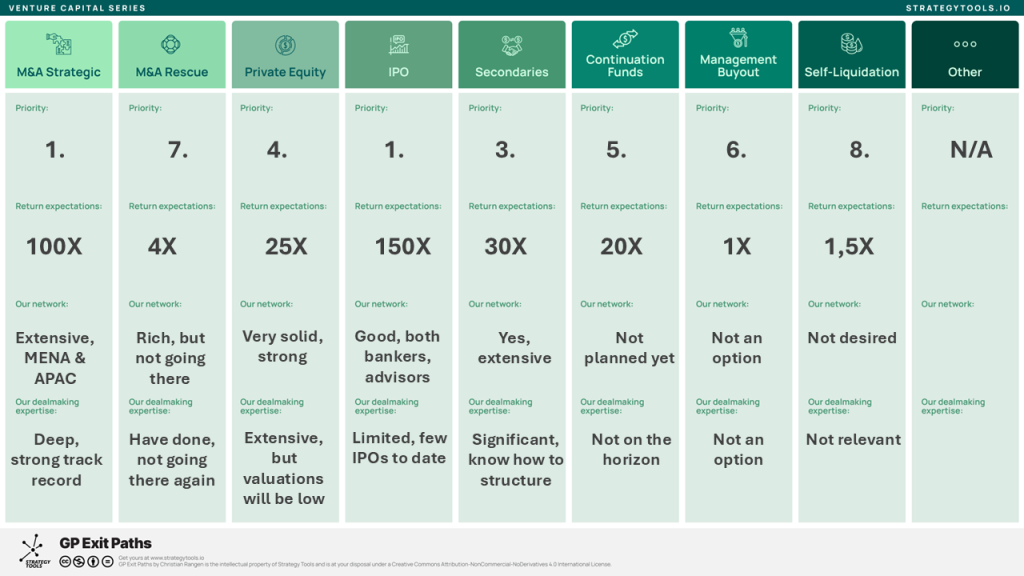
GP Exit Paths, San and Michael worked with the finance team to map out possible paths to liquidity, seen through the lens of GGV
Thanks to San and Michael’s guidance, the finance team managed to get a clear understanding of what an investor like GGV was looking to achieve, and realizing that paths to liquidity was something they had to create, not just wait for.
Tackling Growth Pains, Leadership And Culture Issues
“I had not idea this would take so much of my attention”, Maheen was speaking with her performance coach. She had built Leo into a strong regional brand, with 4.500 employees, and millions of delighted users. But the cracks were starting to show.
Of the top 200 leaders in the company, few had ever scaled a company like this, this fast. Maheen had grown accustomed to focusing externally. “Strategic partnerships, investors, media; that’s been my focus. Now I am realizing my leadership bench is not what I hoped it would be. I am going to spend more time internally, developing the people and culture to carry us forward”, she said.
it was the regular monthly check-ins with Tiffany and Nader that had gotten her to think about the depth of leadership on the team. DFDF had a portfolio-support program, aimed at supporting the fastest growing, high potential companies across their direct and fund portfolios. With over 145 investments, only 5-6 founders got the Scale Coach support from Nader and Tiffany.
Earlier in her work, she had benefitted from the team at Misk Foundation. Now, as the company was working into the Series F, one of the few to ever happen in the region, strong leadership, rapid talent development and focus on culture across 24+ offices would be required. “You have built a rocket ship, but can you steer it?”, Nader had asked over a late dinner at 24th St. World Street Food
Series F – Led By Mubadala
“Mubadala is probably one of the most influential investors in the region. It will be a big win for us”. The board discussion had centered on the recently received term sheet from Mubadala Capital.
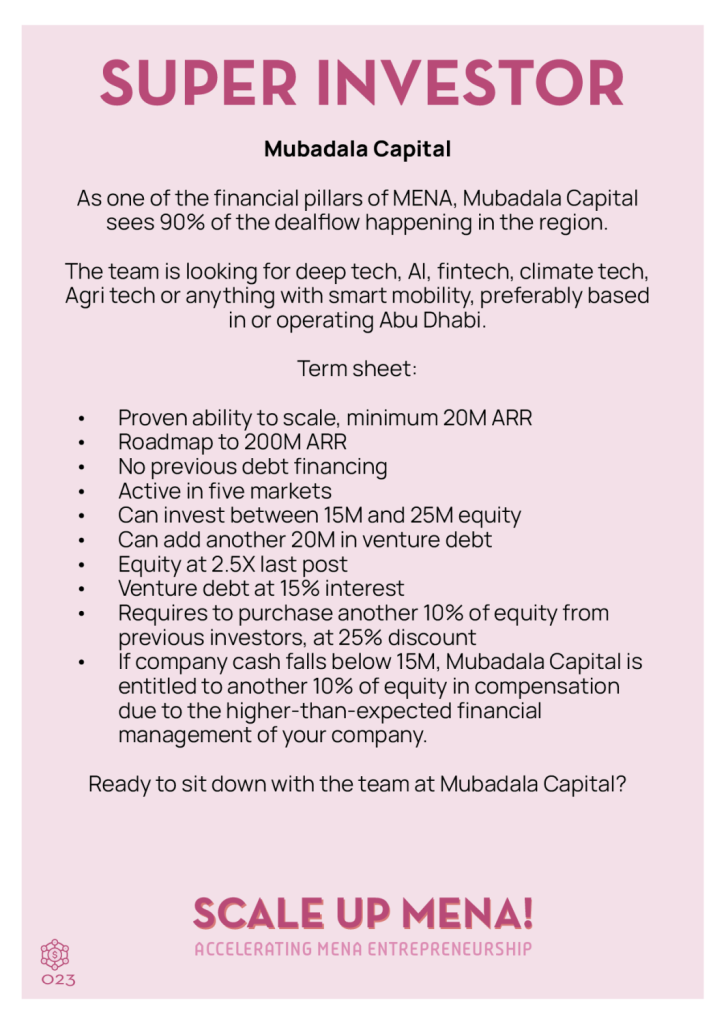
High-level terms sheet from one of the most sought after investors in the region. Used for training purposes in Scale Up MENA!
Mubadala Capital was proposing a multi-tier structure with the following highlights:
– Direct equity $25M @2,5X mark up from last post-money valuation
– Venture debt $20M, with 15% interest
– Secondaries purchase of 10% equity from existing shareholders, with 25% discount
All told, the deal would value Leo at $7,5BN pre-money, and it would give Mubadala a 10,3% ownership post, making them the second largest shareholder after Future Fund Oman.
Interestingly, a key part of the transaction was how Mubadala structed the equity.
$25M would come in a direct investment. But $562M would be used to buy out shares from earlier investors, at a 25% discount, if they could find any takers for it. “Wow, that is both a challenge for us and a great opportunity for our investors to take some money of the table”, Adnan had said. “This is exactly the kind of opportunity I want to be able to present to our investors”, Maheen had said.
The Mubadala Secondaries Transaction
It took a few weeks to structure the transaction, but everyone had been supportive and wanted to help make it happen. “This is just too good to be true”, Liz’s older brother had blurted out when he realized the offer. He and his friends would be able to sell 6.000 shares, continue to hold on to 14.333 shares, and with the sale alone, they would cash out $90M.
Sure, he had expected, or rather hoped for a payout when they first invested in Leo, but nothing, nothing like this.
This deal also allowed for some of the very earliest employees, the ones that had been with Leo since the first year, to cash out some earnings. A total $22M went to stakeholders in the SPV.
“What Mubadala is doing here is superb. The ecosystem really needs more paths to liquidity”, Adnan said to his finance team went they were structuring the secondaries.
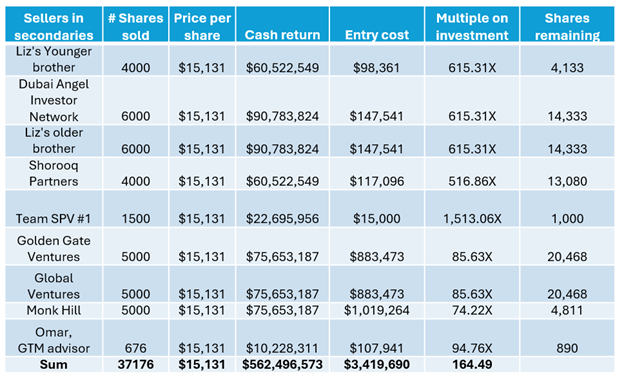
Nine entities, including many early employees came together to meet the 10% secondaries requirements in Series F.
Cap Table Post Series F With Mubadala
With the combined direct and secondary transaction, for a total investment of $587M, Mubadala was coming in as the second largest shareholder, after Future Fund Oman. New in this round was the issue of another 8.000 shares in a new Team SPV, and a dedicated 1,1% equity incentive for the full management team.
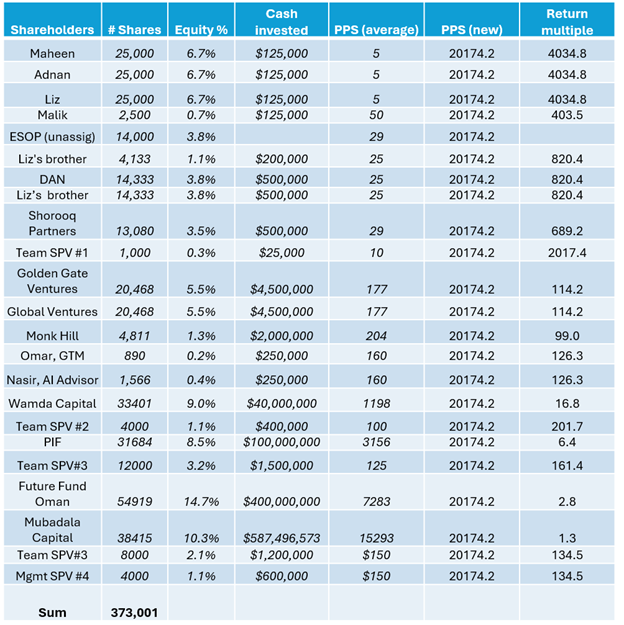
Cap table post Series F. Notice the wide range of return multiples in the last column. Your entry price really matters.
With the updated cap table, Future Fund Oman and Mubadala would be the two largest shareholders, with 15% and 10,3%, respectively. The two investors had invested close to $1BN in direct, and secondary transactions.
Wamda Capital and PIF each held around 8% – 9%, but with very different entry prices, at 1.198 per share and 3.156 per share, respectively.
Collectively, the three remaining founders held exactly 20%, and another 0,8% as participants in the newly set up Management SPV.
In Conversations With Mubadala, The Investment Team Commended Them, “You’ve Really Managed To Structure A Clean And Balanced Cap Table. We Don’t See That Too Often. Well Done.”
Taking On Venture Debt At Scale
“We should really explore venture debt”, the finance team had been looking at more non-dilutive ways to finance the growth.
Oman Venture Financing Company had increasingly become the issuer of choice. In a series of meetings in Oman, the OVFC had emerged as a strategic partner that understood how to aggressively fund market expansion.
“We want to see more high-growth cases emerging out of the region, with the potential to go global”, the Investment Director had said during their discussions. The term sheet came together in a few weeks, where OVFC was willing to finance up to 8X ARR; but recommended capping the debt at 2X ARR. Ultimately, the finance team agreed to a low ARR ratio, with a debt of 600M. At 12%, it was an expensive solution, but the board agreed to the proposition, rather for doing a Series E. The terms were demanding, but the finance team had worked on multiple risk scenarios and were comfortable taking on the debt on said terms.
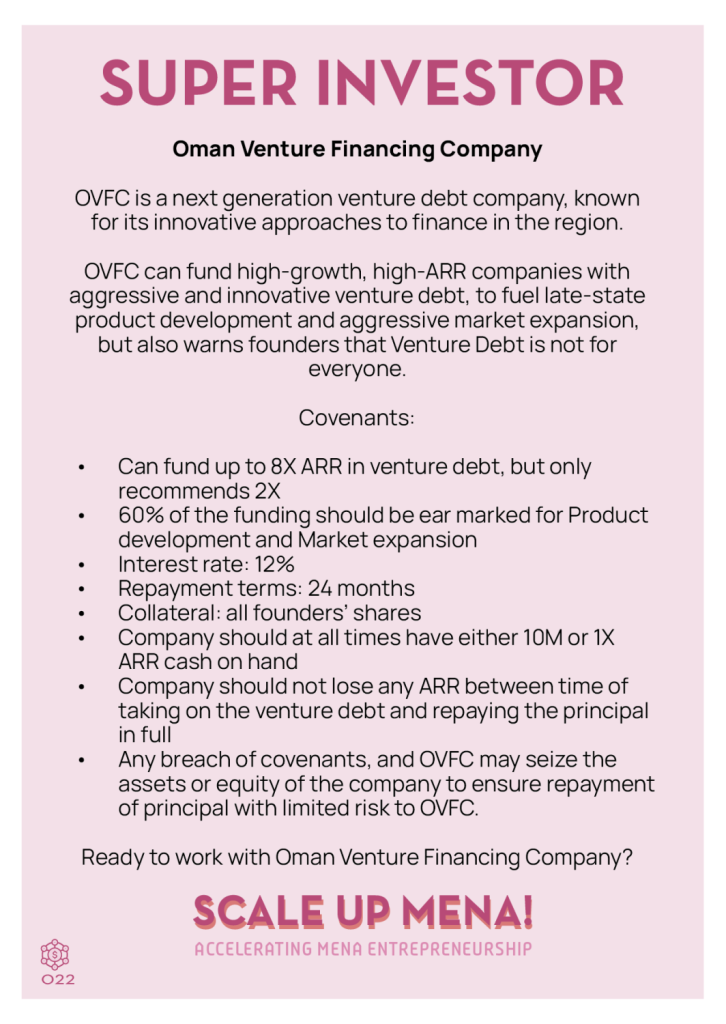
Venture debt should always be a part of your capital stack, just make sure to read the fine print and map out risks, scenarios and notably, worst case scenarios. Not sure the finance team did it well enough here. What do you think?
Negotiating On Incoming Acquisition Offers
Following the investment from Mubadala, it seemed like the entire world came knocking.
Over a period of 3 months, the board received no less than 8 initial acquisition offers. “Things have really changed for us”, Liz said in one of the pre-board meeting discussions. “Yes, but we are not selling, and not selling at any kind of low-end pricing”, Adnan had been clear on that. After all, he and the IR team had promised early investors outlier returns, and he felt a strong, personal desire to deliver on his promise.
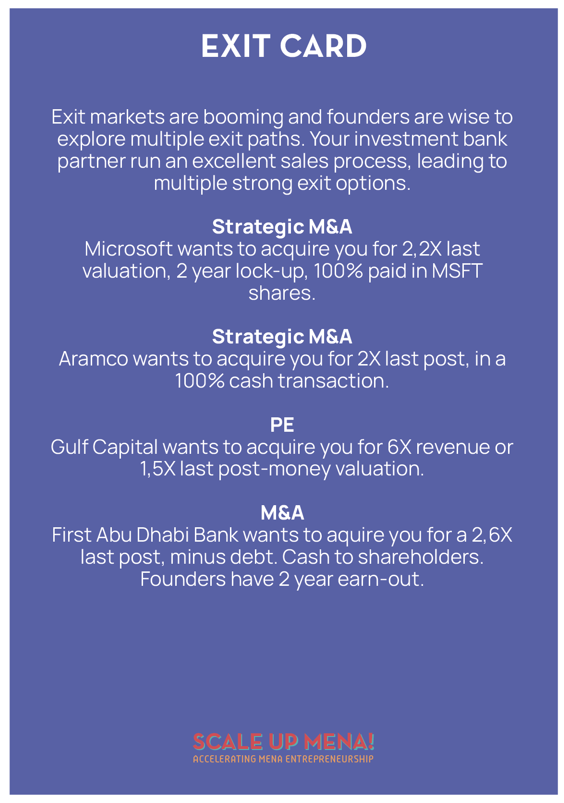
Attractive exit options discussed at the board meeting
Yet, the board took the acquisition offers seriously, recognizing their fiduciary duty to shareholders. For the Q1 board meeting, four offers were looked at serious.
Microsoft was willing to acquire Leo for a 2,2X last valuation, which would take the company to a $16,6BN valuation. But, the deal was paid in Microsoft shares with a 2-year lock up. Nobody really felt good about that option.
Aramco, interestingly enough, was looking to invest into fintech as part of their wider diversification strategy. 2X last post would take the company past $15BN in exit value. Paid all cash, this was a very interesting deal for shareholder. “We are not looking to sell to an energy conglomerate”, Maheen was not interested in going down that route.
Gulf Capital had put in a very interesting proposition, at 1.5X last post, coming in at $11,3BN, but the term sheet revealed a massive debt for the company, effectively taking on more debt than the company could service under its current model. “We just can not recommend this”, Zara, head of risk management had stated.
Finally, First Abu Dhabi Bank had spent months meeting with the team, talking to customers, and probably done the most extensive due diligence by any of the potential acquirers. The M&A team positioned the acquisition as a strong merger amongst equals, looking at Leo as the platform the digital expansion for the Bank.
The team was enticed, and at 2.6X last post, the deal would come in at $19BN. At a $47BN market cap, the deal would be a massive, strategic move by FADB. “Are we really ready to work with a big, established bank, or do we want to chart our own future?”, that was the question the board had discussed
Ultimately, The Board Had Turned Down All Four Aacquisition Offers.
“Give us a few months, let us show you what we can do”, Maheen had said. “My team is accelerating our revenue growth. Our journey is still just beginning”, Liz had followed on with. The board had agreed. “Let’s see where we go from here”, Maryam, Future Fund Oman’s board representative had agreed.
Charting A Strategic Path: Going Public On Tadawul
“Yes, yes, I know, we could choose to go for a Nasdaq listing”. The discussion had been going on for a couple of weeks already. As chairman of the board, James had helped the team really ask some fundamental questions around the path for the next stage of growth.
“You have really sound fundamentals, we can virtually guarantee a successful IPO in New York”, one of the investment banking teams had pitched.
They were right. By now Leo had amassed 16M users, forecasting to hit 40M users in 24 months. The trajectory was insane. Revenue, and notably the recurring part of the revenue mix was following a similar chart, taking Leo to $1.1BN revenue this year, and a target of $2.1BN revenue next year.
In Scale Up MENA! the IPO is one of the most valuable cards a team can get their hands on, but beware, it is complicated…..
“I know we could probably get a higher valuation in New York”, Maheen said. She had been flying between New York, Singapore, London and home non-stop for the past 8 weeks.
“But there is something deeper here. We are a product of the ecosystem. We would never have been here without the vast, extensive help and support we got along the founder’s journey. From the coaching sessions with DFDF, the workshops at Hub71, the angel connections at DAN and the mentors we got from the DIFC meetups. We are a product of the ecosystem, and I would like to make sure we are now finally in a position to give back to that ecosystem”, Liz had fully agreed, while parts of the board was still contemplating a NY IPO.
The board had run an investment bank beauty contest, inviting eight banks to pitch for the IPO process. The shortlist had come down to Goldman Sachs and a strong, local team in MENA, led by Emirates NBD Capital.
“Listen, when we set out to build Leo, we aspired to outperform Careem. We have achieved that. Now, we have the chance of really stepping it up one step further. Talabat was a marquee IPO for the region. We could choose to work with the same team, the team that listed Talabat. We could aim big and try to secure an IPO that would exceed Talabat”, Adnan had grown increasingly impressed with the local team, led by Emirates NBD Capital.
Ultimately, The Board Decision Was Clear. Leo Would Go For A Local LPO, Led By A Total Of 9 Investment Banks, Under The Guidance Of Emirates NDB Capital.
Listing Advisor: Emirates NBD Capital PSC acted as Listing Advisor
Joint Global Coordinators: Emirates NBD Capital PSC, J.P. Morgan Securities PLC, and Morgan Stanley & Co International PLC as joint global coordinators and joint bookrunners
Joint Bookrunners: Abu Dhabi Commercial Bank PJSC, Barclays Bank PLC, EFG-Hermes UAE Limited, First Abu Dhabi Bank PJSC, Goldman Sachs Bank Europe SE, ING Bank N.V., and UniCredit Bank GmbH as joint bookrunners
Legal Advisor: Linklaters
“This is exactly the same team that Talabat used, I have high expectations here”, Maheen had concluded with the board as the company and its line up of advisors started preparing to take Leo public.
Understanding Ultimate Ownership And The Impact On The Ecosystem
During one of their flights to Abu Dhabi, Adnan and Maheen had sketched out something interesting. It was a chart of the ultimate shareholders, owners, investors in Leo. “Our cap table is pretty easy, with 22 entities listed. But I’ve been thinking. In total we now have more than 4000 employees in our SPV’s, we have 24 angel investors from DAN, we have five VC funds, each with 20 – 250 limited partners behind them. By my account, we have more than 5000 people as direct or indirect owners in Leo, and that is not counting our larger funds”, he said.
“Imagine the impact on the region, on the ecosystem, when we go public. It has been a long, 7-year journey already, but this could have a massive impact on the ecosystem, and create a lot of wealth for the people that believed in us early, not to mention the early employees that have been with us since the early days.” , Adnan said as the plane was starting to descend on Abu Dhabi.
IPO Readiness
“Ok, there are still some requirements to sort through”. The team from Linklaters had prepared the legal brief for the team and board.
“30% free float and one-year lock up is easy. The challenge is how we choose to restructure the cap table, and ultimate ownership to meet the requirement of 200 unique shareholders at the time of listing”, the Managing Partner at Linklaters said. The legal team had worked on finalizing the paperwork alongside the Issuer team in Riyadh.
The Decision Had Been Made. Leo Was Going Public On Tadawul.
Roadshow And Valuation Multiples
In the roadshow materials, there was one key slide that had stood out.
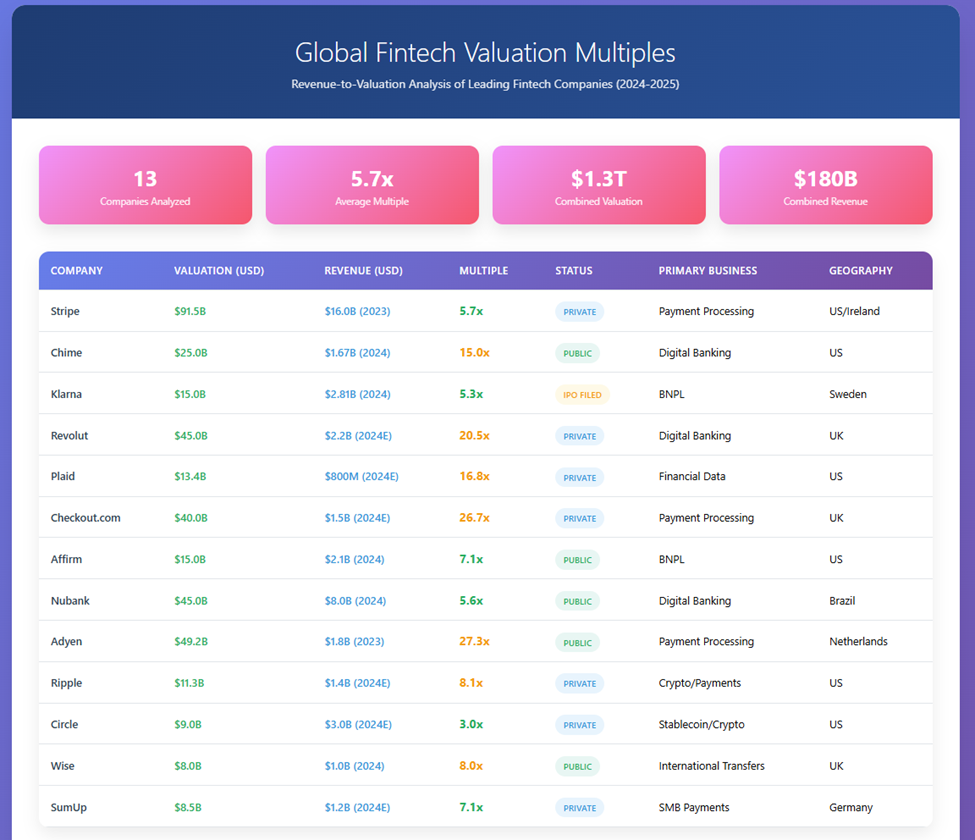
How does Leo stack up vs. global peers?
At $2,1BN revenue and a $13,5 target IPO value, Leo got a 6.4X valuation-to-revenue multiple. Post IPO, with new equity in, Leo would be looking at a 9,3X multiple. “Leo will be one of the fastest growing fintechs to go public, and compared to Chime, Adyen and Revolut, there is still massive upside for new investors”, the team from Emirates Capital and Morgan Stanley had repeated in investor meetings.
That Slide Had Sealed The Decision For Most Cornerstone Investors In The LPO.
IPO Celebration

The founders during the IPO, the third biggest IPO ever in MENA
“Wow, what a day. Do you guys remember the first sketches we made back at the Starbucks at DIFC?”, Liz was euphoric. “It truly has been a journey”, Adnan smiled. They had grown the team to 5.000+ people, scaled to 35M users and well over two billion in revenue.
“But, remember, we are just getting started”, Maheen followed up.
The Team From Emirates Capital Had Been Clear. “Some People Call It An Exit. It Is Not. Going From A Privately Held Company To Becoming A Public Company Is Not An Exit. It Is A Transition. It’s A Step On Your Founder’s Journey.”
The decision had been made to raise $6BN in new equity at the IPO. The listing had been massively oversubscribed, indicating a strong demand for new tech companies in the region. PIF and Mubadala had been exceptionally helpful on the roadshow, often joining the management team on the road.
Based on market feedback, the valuation was set at $13,5BN at listing, outperforming the $10BN Talabat listing a few years earlier. “The biggest tech IPO this year”, Forbes Middle East plastered on the front page. Financial Times called Maheen “the rocket ship CEO, guiding the biggest listing in years”.
The $6BN raise at a $13,5BN valuation also passed the requirements of a 30% free float in the market.
“We are proud to give the public a chance to invest in Leo today. Since our launch we have tried to build and scale the bank of the future for the MENA region. At today’s IPO shows strong interest in the stock, but we are only just getting started. The best parts is still ahead of us”, Maheen said on CNN Market Watch with Becky Anderson.
CAP TABLE AT IPO
Based on Saudi Arabian listing requirements, a total of 30,7% of Leo’s shares were made available in a free float, or IPO pool. This would allow the company to raise $6BN and becoming the third largest IPOs ever in the Middle East, just behind Aramco and DEWA.
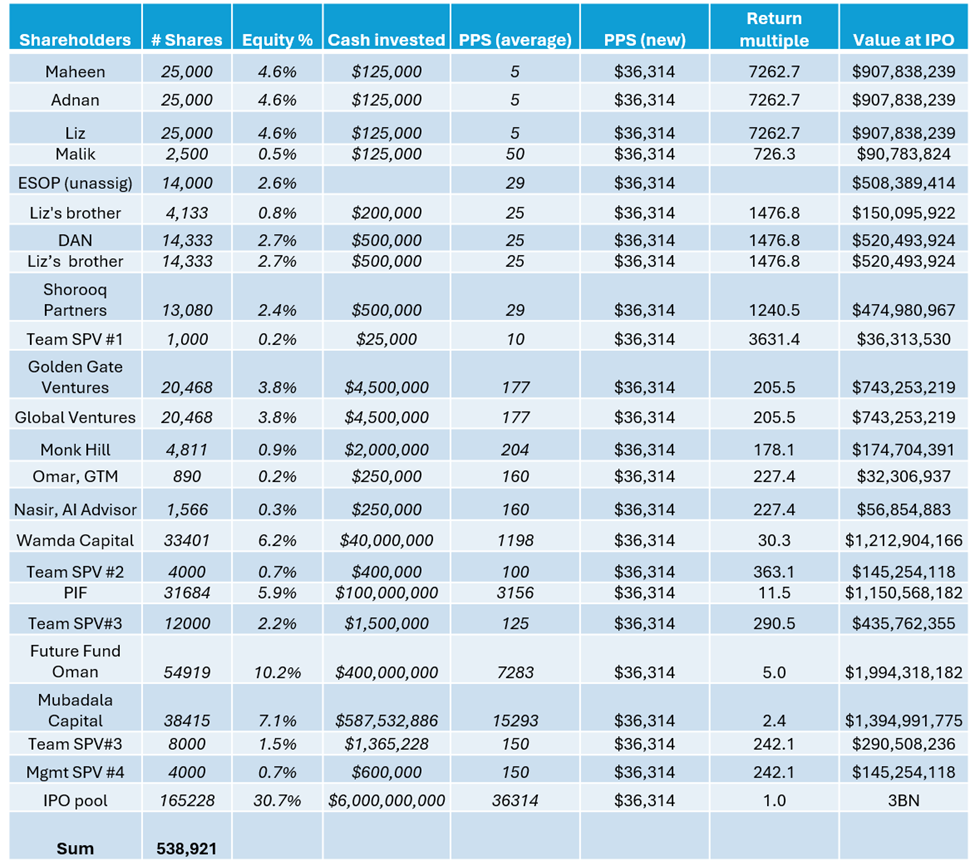
Cap table at IPO, raising $6BN, meeting the 30% free float requirement and setting the company up for the next growth phase. IPO is just one step on the journey.
“At A 1.240x Return, This Has Been One Of The Most Amazing Founder Journeys Ever, In Mena”, Having Backed Leo Since The Early Days, Shorooq Partners Were Delighted To Announce The Outcome For Their Limited Partners On An Update Call On The Same Day As The LPO. It Was A Huge Win For Their Fund.
“We are delighted to back the next generation of fund managers in the region, and the team at Shorooq has shown what is possible when we develop strong, outperforming GP teams in the region. We are not surprised to see, but wish to congratulate the entire team with this big win”, DFDF’s Mahmoud Ward said in a statement to the Wall Street Journal. DFDF stood to take home a 14x net DPI on the back of an excellent portfolio in Shorooq Fund IV.
Shorooq Partners, Golden Gate Ventures and Global Ventures, Monk Hill all secured a coveted Dragon in backing Leo. A Dragon, or a single deal, that ends up returning the whole fund, is about 4X as rare as securing a unicorn. For fund managers, it marks the entry into the global top league of VC investors.
One of the big winners in the IPO had been Wamda Capital. With their record $40M investment, at $300M valuation, many had said they were crazy, investing at far too high a valuation. “Many said the deal would never, ever return back much”, Wamda’s Managing Partner said on a podcast with MAGNiTT. “but, hey, we saw the potential, we believed in the team and we believe in the rapidly maturing ecosystem. Our $40M investment returned us 30X, for a total valuation of $1,2BN”.
“Dude, That’s The Stuff That Legends Are Made Of”, Philip Had Said On The Podcast.
PIF returned back 11X, but decided to stay on as a long-term investor, also taking a minor post at IPO, to indicate further backing of Leo. Looking back, Mubadala’s decision to do the $530M secondary was a genius stroke, as the investment secured a 2,4X return. Not bad for a late-stage deal.
Employees, now counting 5.000+, all made out very well with the Special purpose vehicles. After the IPO, 3,2% was owned by employees and management, with another 2,6% available to secure future talent in the ESOP.
“We are immensely proud to see homegrown talent choose to launch, scale and list in the region. This talented group could have chosen to build anywhere, but they choose MENA, and what a journey they have had. We are proud to be early backers and we are delighted to see the ripple effect of this success story in the region”, speaking at the annual MEVCA Investor Summit, Dubai Angel Network Chairman was delighted.
Dan Had Made More Than $611M, Off Of Their $500.000 Investment At Pre-seed. “we Got A 1.222X Return On The $500.000 We Invested. This Stands As One Of The Best Angel Investor Deals Ever, Fully On Par With The First Angel Investors Into Google And Ebay Back In The Days. Now, We Hope To See Many More Deals Like This, As The Leo Mafia Start Launching The Next Generation Of Start Ups Here. We Stand Ready To Invest.
Of course, the three remaining founders, Liz, Adnan and Maheen, each hit an equity valuation of $907M at IPO. With various management incentive programs, combined with strong upside potential in the stock, most analysts predicted this could rise to $1,5BN within the next 2 years, minting three new billionaires in the region. Lock-up and market expectations would mean this would not get liquidated to cash anytime soon, but generational wealth was being created in the MENA ecosystem.
Speaking as the opening keynote speaker at Dubai FinTech Summit, Maheen shared her thoughts on the future of Leo. “This truly was the result of the ecosystem coming together, maturing. When we started, we knew little beyond raising a few SAFE notes and a seed round. We got extensive help and support, coaching and mentoring. We secured great talent, we build a world-class board. But, in sum, we owe our success to the entire MENA ecosystem. We are truly coming of age, all of us. Looking ahead I believe the best is clearly yet to come”.
The End. For Now.
Make sure you also read part I: the early days (start up, seed): and part II: scaling up (Series A,B).
Did You Enjoy Leo’s Journey?
What did we get right? What is clearly wrong? Where would you have liked the team to go differently? Let us know in the comments.
Scale Up MENA! Launching In August 2025
In Scale Up MENA! you and your team members step into the shoes of a founder team in MENA, just like Liz, Maheen, Adnan and Malik.
You select amongst 30+ case companies. Your task: scale your new case company from an early idea to a successful exit, while also competing with 3 to 20+ other teams, all trying to outcompete and outrace you. Along the way, manage the nine building blocks Maheen identified early on, raise multiple rounds of financing, accelerate revenue velocity, scale with AI tools and try to outcompete the likes of Careem, Tabby and Talabat.
Along The Way, You Learn How To Read Term Sheets, Structure Investment Rounds, Develop Your Growth Strategy, Build Paths To Liquidity, Speak In Investor Outcome Terms And Complete An Exit Transaction – All Core Skills You Need To Scale Your Real-life Start Up
Globally, more than 3.500 founders, investors and ecosystem builders have mastered cap tables, growth strategy and exits with Scale Up! Now, for the first time, we are ready to launch a 100% MENA version.
Scale Up Mena! From Idea To Exit Is One Of The World’s Leading Methods To Accelerate A Startup’s Successful Growth Journey. The Scale Up Mena! Masterclass Is Designed To Help Founders Understand How To Lead Through The Founder’s Journey, From Idea To Ultimate Exit.
Handle early-strategy, product development, AI, SAFE notes, local accelerators, venture financing, market expansion, ARR growth, growth financing, market leadership and exit transaction – all based on real content from across the MENA region.
Launching August 2025. Learn more.